
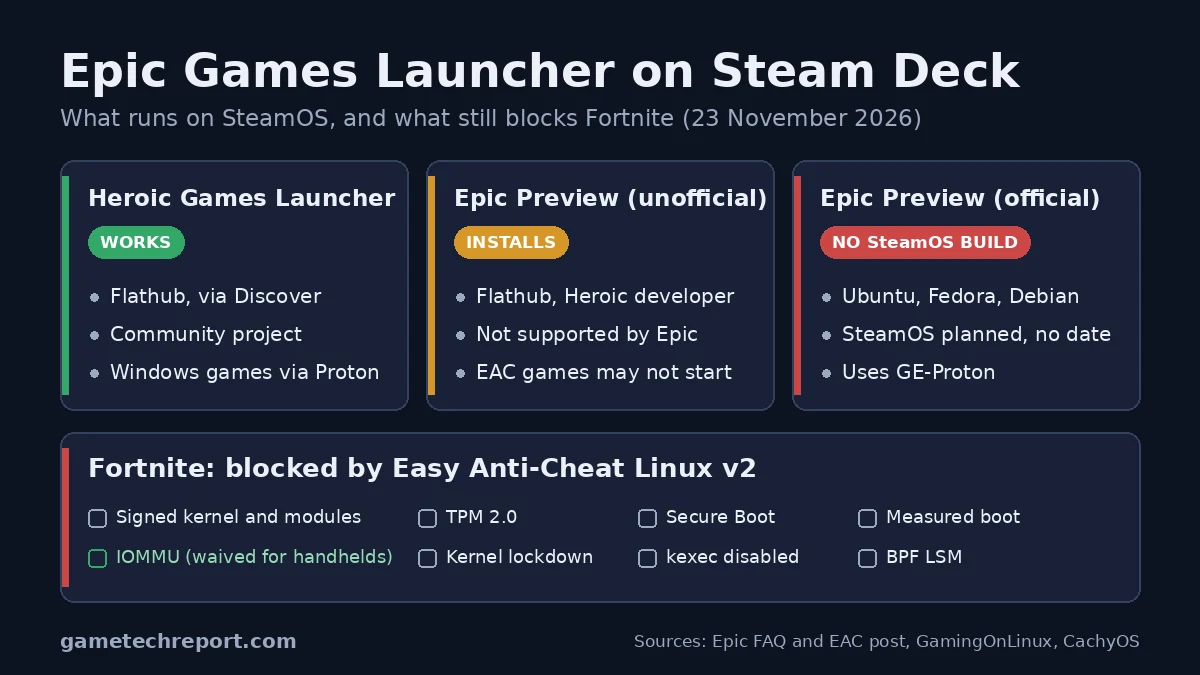
Epic has promised SteamOS support for the native Linux version of the Epic Games Launcher, but as of 23 November 2026 there is no official Steam Deck build and Fortnite still won’t run on Valve’s handheld. Until that changes, Steam Deck owners reach their Epic library through Heroic or an unofficial package of Epic’s preview.
SteamOS is promised but missing from Epic’s FAQ
The launcher FAQ names Ubuntu 22.04 LTS or newer, Fedora 43 or newer and Debian 12 or newer as supported, leaves every other distribution untested, and warns that many games are Windows-only builds that may need a compatibility layer. The preview went public on 14 October 2026. Its release notes up to version 0.120.0, dated 20 November 2026, list Linux fixes for blank store pages, the system tray and Unreal Engine installs, but none for SteamOS.
The SteamOS promise comes from Epic communications director Jake Jones, who told GamingOnLinux in early November 2026 that Epic plans to support “Fedora, SteamOS, Cachy, Omarchy, and more.” He gave no date and said packaging formats were still being tested.
Heroic is still the simplest route on the Deck
| Route | Install on SteamOS | Supported by Epic | Windows and anti-cheat games |
|---|---|---|---|
| Heroic Games Launcher | Flathub, through Discover in Desktop Mode | No, open-source project | Wine or Proton; anti-cheat games only where the developer allows Proton |
| Epic Games Launcher Preview, unofficial Flatpak | Flathub, packaged by a Heroic developer | No | Launcher’s own Proton setup; Rocket League failed to start in GamingOnLinux’s test |
| Epic Games Launcher Preview, official | No SteamOS build | Yes, on Ubuntu, Fedora and Debian | GE-Proton, set up the first time a Windows game starts |
Heroic needs Desktop Mode only for the setup. Switch to Desktop Mode, install it from Discover, sign in with the Epic account and install games there. Added to the Steam library, those games show up in Game Mode like any other.
An unofficial Flathub package of Epic’s own preview appeared in mid-November 2026. A Heroic developer maintains it, outside Epic’s support. In GamingOnLinux’s test it launched Absolute Drift, while Rocket League, an Easy Anti-Cheat game, failed to start, and the site suspects the Flatpak trips up anti-cheat games.
Game Mode is the open question for an official build. Epic has said nothing about a controller interface or about adding games to Steam, two things Heroic users already rely on.
Fortnite needs eight boot checks, and the Deck fails at least one
Epic announced Easy Anti-Cheat Linux v2 on 14 October 2026 and picked Fortnite as its first game, with no release date for Linux. The new anti-cheat loads no kernel module of its own. It checks how the system booted instead, against this list:
- a signed kernel and signed modules, including out-of-tree drivers such as NVIDIA’s;
- TPM 2.0 enabled in the firmware;
- Secure Boot with well-known keys only;
- measured boot;
- IOMMU enabled with passthrough off, on non-handheld devices;
- kernel lockdown in integrity mode;
- kexec disabled;
- the BPF Linux Security Module loaded and active.
Handhelds are exempt from the IOMMU check, so Epic planned for devices like the Deck. The FAQ in the same post says the Deck lacks “the required features” without naming them, and that Epic is talking with Valve. Firmware and the way SteamOS signs and boots its kernel are both in Valve’s hands, so the gap closes either with a Steam Deck BIOS or SteamOS update or with another exception from Epic.
CachyOS already ships a signed EAC kernel
CachyOS shows what meeting the list takes on a desktop distribution. Its November 2026 release, published on 22 November 2026, adds a linux-cachyos-eac kernel signed with a key Epic trusts, a matching signed systemd-boot and a separate boot entry, so the regular kernel stays untouched. The EAC kernel runs in lockdown and loads only signed modules, which rules out DKMS, so the NVIDIA, ZFS and r8125 drivers come as linux-cachyos-eac packages. Anyone who unlocks a disk with the TPM is told to read the CachyOS guide first. The release names no game, Fortnite included.
A game that moves to EAC Linux v2 would lose the Deck
Epic games on the Deck still run through Proton, and anti-cheat games work where developers allow it. Epic lets developers with existing EAC Linux support keep the older implementation or switch to v2. A game that switched to v2 only would stop running on the Deck until Valve and Epic close the gap, and Epic has named none that plans to.
The same rules reach other SteamOS hardware, because SteamOS is spreading beyond the Deck. The Steam Machine is a desktop, so it would also have to pass the IOMMU check that handhelds skip.