
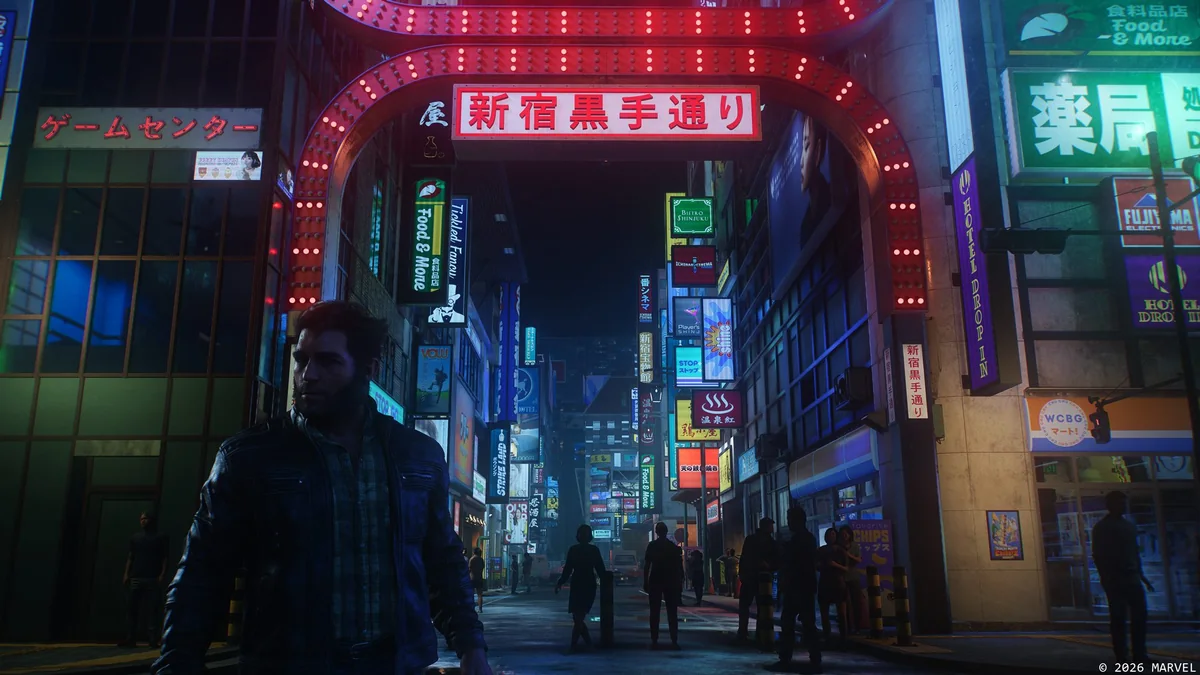
Sony has brought machine-learning image reconstruction to the standard PlayStation 5 with Quick Spectral Super Resolution (QSSR), starting with patches for Marvel’s Wolverine and Ghost of Yōtei.
The announcement matters beyond two new graphics options. Sony has built a performance-focused reconstruction path for the 2020 console, while early testing suggests that games already designed around PS5 Pro’s PSSR may have a comparatively short route to QSSR support.
- QSSR now runs on the standard PS5, without PS5 Pro’s dedicated machine-learning hardware.
- Marvel’s Wolverine uses it by default on the base console.
- Early testing shows a measurable GPU cost, rather than free performance.
- Existing PSSR titles may be easier to adapt, although support still requires developer work.
That does not make QSSR a free PS5 Pro upgrade. The standard console still has tighter compute limits.
The practical gain is different: developers can trade some internal rendering resolution for a cleaner reconstructed image, potentially improving the weakest part of many performance modes without changing the base hardware.
QSSR runs on PS5 without PS5 Pro’s dedicated ML hardware
Sony describes QSSR as a new “performance tier” of AI upscaling derived from Project Amethyst, its graphics collaboration with AMD.
Compared with PSSR, Sony says the base-PS5 implementation uses a streamlined neural-network architecture and code tuned specifically for the console. Sony is also explicit that PSSR remains its higher-end solution on PS5 Pro.
The hardware difference shapes how the two techniques are used. In Digital Foundry’s technical coverage, Sony principal engineer Daniel Craig explained that the standard PS5 does not have the same dedicated machine-learning hardware available to PS5 Pro.
QSSR therefore leans primarily on FP16 math rather than simply running the Pro implementation unchanged. It is a related, performance-focused reconstruction path built around the limits of the older machine.
Wolverine shows better reconstruction from a lower internal resolution
Insomniac’s Marvel’s Wolverine update 1.002.000 makes QSSR the default on the standard PS5.
Digital Foundry’s uncapped performance-mode test gives an early picture of the tradeoff. QSSR reconstructed a roughly 864p internal image to a 1440p output and took about 1.5–1.8 milliseconds longer than Insomniac’s previous upscaler in that test.
That translated to roughly an 8–10 FPS difference while the frame rate was uncapped.
The normal 60 FPS mode changes the picture because dynamic resolution scaling can lower the internal resolution to absorb part of that extra processing cost.
QSSR is therefore not creating performance from nothing. In the Wolverine test, the game can render fewer pixels to stay near its frame-rate target, then use QSSR to reconstruct a cleaner and more stable output than the previous solution produced.
Digital Foundry also measured a roughly 4.4ms hit in a separate Wolverine fidelity-mode test targeting 2160p. Because the two tests use different graphics modes, that difference cannot be attributed to output resolution alone.
Even so, Digital Foundry concluded that 1440p is a more natural target for QSSR on the standard PS5 than reconstructed 4K.
Ghost of Yōtei puts QSSR close to FSR 3 in one early test
Ghost of Yōtei produced a different result. With its performance mode uncapped under VRR, Digital Foundry measured QSSR running almost identically to the game’s existing FSR 3 implementation.
That is encouraging, but it is not enough to call the two techniques equal in cost. The testers cautioned that comparable input and output resolutions still need to be confirmed, and one game cannot establish a general performance rule.
The comparison instead shows that QSSR’s cost can vary substantially by game and graphics mode, leaving developers room to decide where it fits.
Sony’s own pitch for Ghost of Yōtei focuses on fine-detail reconstruction and temporal stability — exactly the areas that become difficult when foliage, thin geometry and camera motion have to be reconstructed from a lower-resolution image.
Existing PSSR games have a shorter path to QSSR
The most consequential detail may be integration rather than image quality.
Craig told Digital Foundry that QSSR is “fundamentally a drop-in replacement” for titles that already support PSSR. The implementation is not literally automatic: he said game settings may still need a few days of tuning, including streaming changes so higher-quality mip levels remain resident in memory.
Even so, he characterized retrofits as relatively easy and low risk.
That matters because developers have already done much of the renderer-side work required to support PSSR on PS5 Pro.
It does not mean every PSSR game will receive a base-PS5 QSSR patch, and Sony has announced no automatic compatibility layer. It does mean the technical barrier is lower for studios that decide the image-quality improvement is worth revisiting an existing title.
Sony says the QSSR library will be offered broadly to PlayStation developers, so adoption now depends more on individual game budgets, targets and developer priorities than on access to the technology.
QSSR narrows the image-quality gap without turning PS5 into PS5 Pro
The first two implementations make the boundary fairly clear.
QSSR can let the standard PS5 start from a lower internal resolution and still reconstruct a cleaner, more stable image, but the reconstruction itself consumes GPU time. PS5 Pro retains dedicated machine-learning hardware, PSSR and more room to target higher internal and output resolutions.
For the base console, the more interesting question is how many developers can use QSSR to improve modes that already sacrifice image quality to hold 60 FPS.
If the PSSR-to-QSSR retrofit remains as light as Sony describes, the technology has a plausible route beyond its two launch games. The result would not erase the hardware gap; it would give developers a better tool for managing it.
Sources: Sony Interactive Entertainment / PlayStation Blog; Digital Foundry hands-on testing and Daniel Craig interview; Insomniac Games patch notes for Marvel’s Wolverine 1.002.000.