
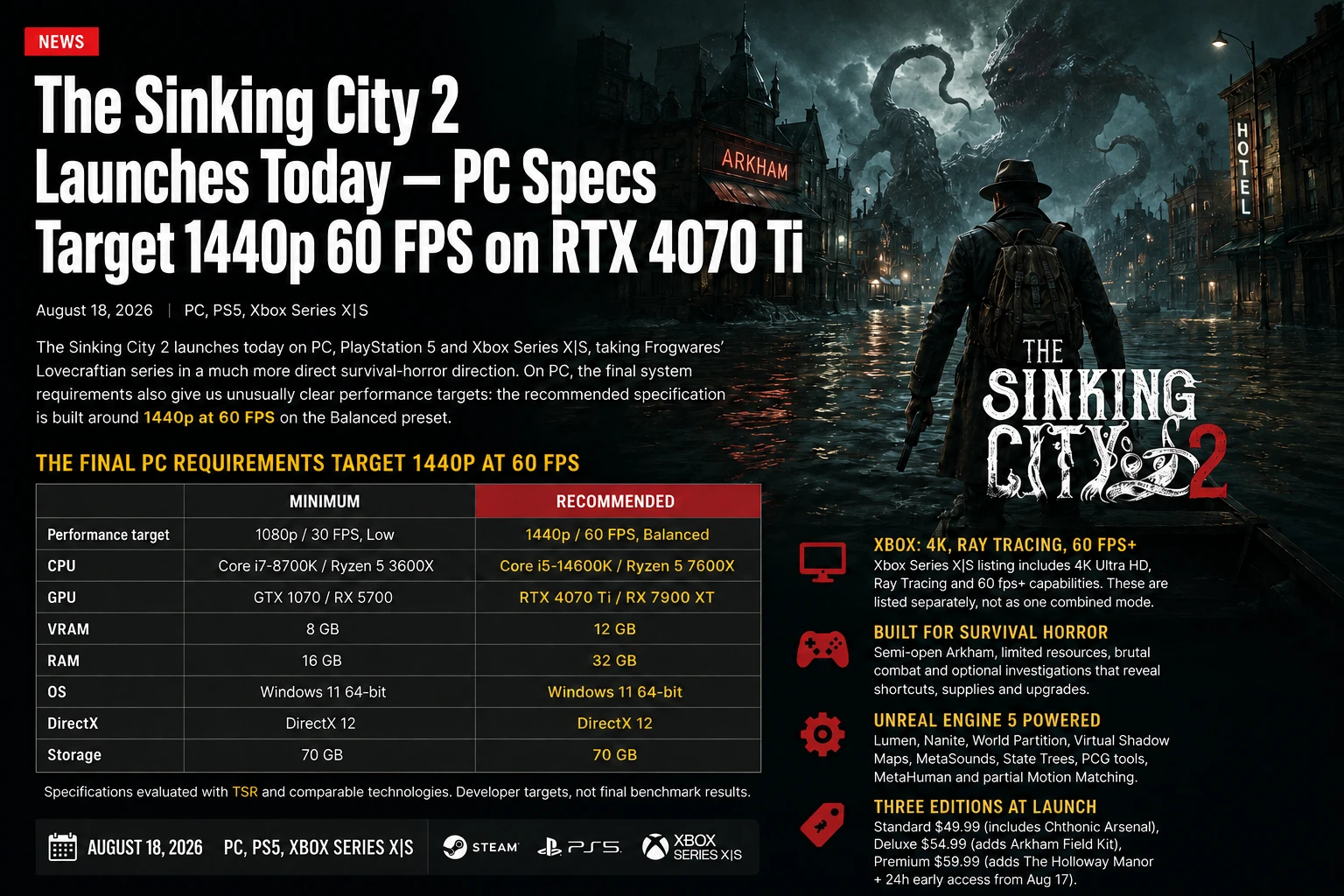
The Sinking City 2 launches August 18 for PS5, PC, and Xbox Series X|S, with Frogwares providing clear performance targets for both PC specification tiers. The recommended hardware targets 1440p at 60 FPS on the Balanced preset, while the minimum tier is aimed at 1080p at 30 FPS on Low.
For the 60 FPS target, Frogwares recommends an RTX 4070 Ti or RX 7900 XT alongside 32 GB of RAM. The studio also notes that the specifications were evaluated using TSR and comparable technologies.
The recommended PC tier targets 1440p at 60 FPS
The recommended configuration pairs an Intel Core i5-14600K or AMD Ryzen 5 7600X with an RTX 4070 Ti or RX 7900 XT. Steam lists 12 GB of VRAM as the recommended requirement, along with 32 GB of system memory, Windows 11 64-bit, DirectX 12, and 70 GB of storage.
| Minimum | Recommended | |
|---|---|---|
| Performance target | 1080p / 30 FPS, Low | 1440p / 60 FPS, Balanced |
| CPU | Core i7-8700K / Ryzen 5 3600X | Core i5-14600K / Ryzen 5 7600X |
| GPU | GTX 1070 / RX 5700 | RTX 4070 Ti / RX 7900 XT |
| VRAM | 8 GB | 12 GB |
| RAM | 16 GB | 32 GB |
| OS | Windows 11 64-bit | Windows 11 64-bit |
| DirectX | DirectX 12 | DirectX 12 |
| Storage | 70 GB | 70 GB |
The minimum tier drops the target to 1080p at 30 FPS on Low. It calls for a Core i7-8700K or Ryzen 5 3600X, a GTX 1070 or RX 5700, 16 GB of RAM, and 8 GB of VRAM. The biggest differences between the two tiers are the GPU class, the amount of system memory, and the jump from 30 to 60 FPS.
The performance targets are developer guidance, not benchmarks
Steam ties each hardware tier to a resolution, frame rate, and graphics preset, making the requirements easier to interpret. They are still developer targets, however, and do not tell us how consistent frame pacing will be or which individual settings will have the largest performance cost.
Frogwares also says the specifications were evaluated using TSR and comparable technologies. The listed 1440p figure may therefore involve reconstruction rather than native 2560×1440 rendering. Release-build benchmarks will be needed to show how closely the game holds its 60 FPS target.
Frogwares is using several of Unreal Engine 5’s major rendering and world-building systems. The Sinking City 2 uses Lumen for dynamic lighting and reflections, Nanite for more detailed environments, and World Partition for its semi-open-world areas. The project also uses Virtual Shadow Maps, MetaSounds, State Trees, and PCG. The studio has highlighted Lumen in particular for lighting and reflections across Arkham’s many wet surfaces.
The sequel shifts toward survival horror
The sequel also moves away from the first game’s detective-first structure. Frogwares describes The Sinking City 2 as a semi-open-world survival horror with a stronger emphasis on combat, exploration, and resource management.
Investigations are still part of the game, but they no longer gate progress. Optional cases can reveal safer routes, supplies, upgrades, and other useful information, while the main story is designed to stand on its own without requiring knowledge of the first game.
For returning players, the practical change is clear: combat and resource management play a bigger role, while investigations move into optional content that can make later encounters easier.
The 60 FPS target comes with a steep GPU jump
The gap between the minimum and recommended GPUs is large: GTX 1070 or RX 5700 at the low end versus RTX 4070 Ti or RX 7900 XT for the recommended 60 FPS target. System memory also doubles from 16 GB to 32 GB.
Frogwares ties the recommended hardware to a specific target: 1440p, 60 FPS, and the Balanced preset. Independent testing will show how consistently the release build reaches that target in demanding areas and how much performance can be recovered by lowering individual settings.
Sources: PlayStation Blog, Frogwares / Steam, Epic Games / Unreal Engine, and Xbox.