
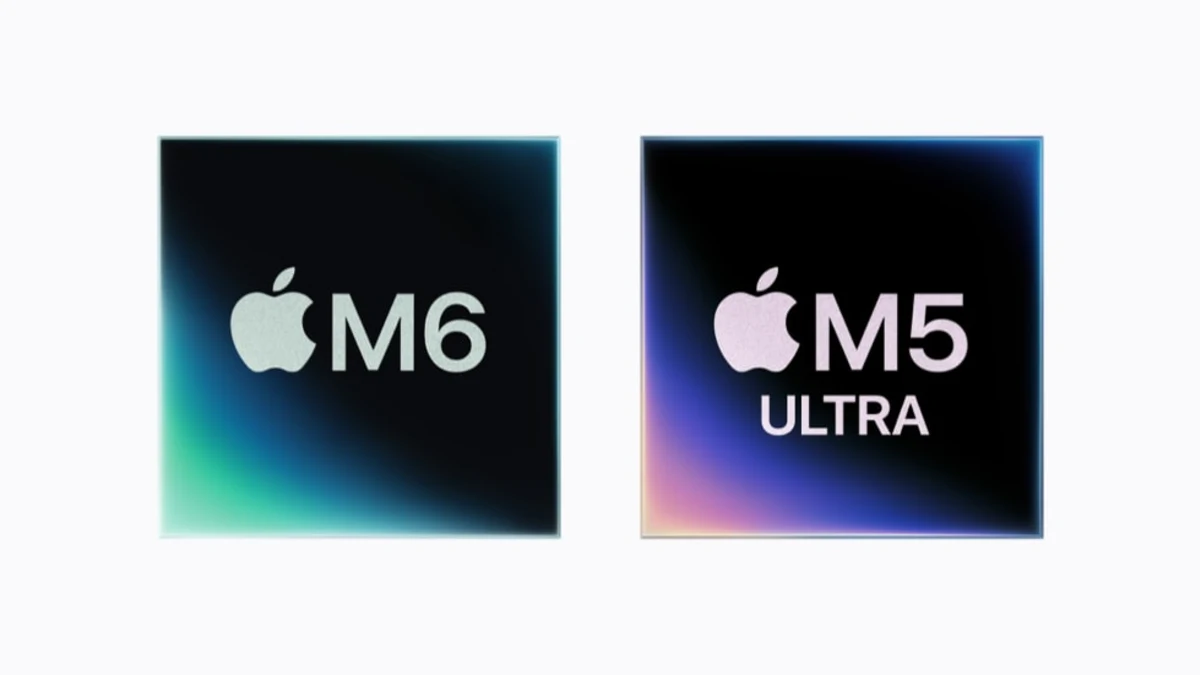
Apple is moving its mainstream desktop silicon to 2nm with the M6, and the first Mac to use it is a new Mac mini starting at $899 in the United States. The chip pairs a 12-core CPU with a 12-core GPU, a Dual 16-core Neural Engine and up to 170GB/s of unified-memory bandwidth.
The new chip also adds two CPU cores and two GPU cores over M5, puts a Neural Accelerator in every GPU core, and revises the shader, Dynamic Caching and ray-tracing hardware. Apple is pitching those changes across AI, graphics and gaming workloads, but the performance figures in its launch material come from the company’s own preproduction testing.
M6 is Apple’s first move to 2nm
M6 uses a 12-core CPU made up of two super cores, four performance cores and six efficiency cores. Apple says multithreaded CPU performance can be up to 1.2 times higher than M5, while the 12-core GPU raises peak AI compute and adds updated shader cores, Dynamic Caching and hardware-accelerated ray tracing.
Unified memory tops out at 32GB on M6, with 170GB/s of bandwidth, 10% more than M5. The base Mac mini starts with 16GB. Buyers who need more than 32GB have to move to the M5 Pro version, which supports up to 64GB and 307GB/s.
The $899 Mac mini gets more compute, not more base memory
Pricing starts at $899 for the M6 Mac mini and $1,699 for the M5 Pro version. Both are available to preorder from August 25 and are due in stores on September 22. The enclosure is unchanged, but connectivity moves forward with Wi-Fi 7, Bluetooth 6 and 2.5Gb Ethernet as standard, with 10Gb Ethernet available as an option. Port speeds differ between the two models: M6 keeps three rear Thunderbolt 4 ports, while M5 Pro uses three rear Thunderbolt 5 ports.
Base memory remains 16GB on the M6 model, configurable to 32GB. The $899 starting price is $100 above the $799 entry point immediately before this refresh, while the M4 Mac mini originally launched at $599 in 2024. Measured against the 2024 launch price, the longer-term increase is $300, but it did not happen in a single step. PC component pricing has also been volatile this year — our August DDR5 comparison across European retailers found large gaps for identical kits — although Apple has not tied the Mac mini increase to memory costs.
Ray tracing gets a concrete gaming benchmark
Apple’s gaming benchmark uses Cyberpunk 2077: Ultimate Edition. The company says the M6 Mac mini can run the game with ray tracing at up to twice the performance of an M4 Mac mini. That is a specific Apple-run comparison, not evidence of a general 2x gaming uplift across the Mac library.
The GPU also has 50% higher geometry rates and nearly 30% more peak GPU compute for AI than M5, according to Apple. Those numbers still need independent testing across a wider mix of games and creative workloads.
M5 Ultra takes a different route with four dies
M5 Ultra uses a different architecture. It connects two dual-die M5 Max chips through UltraFusion to create Apple’s first quad-die M-series design. The interconnect provides more than 4.4TB/s of die-to-die bandwidth, while the finished chip scales to a 36-core CPU with 12 super cores and 24 performance cores, an 80-core GPU and a 32-core Neural Engine.
Memory capacity reaches 512GB of unified memory on the new Mac Studio, with 1.2TB/s of bandwidth. Apple is positioning that capacity primarily for local AI, large datasets and professional graphics work rather than consumer use. The M5 Ultra Mac Studio starts at $5,499, while the M5 Max model starts at $2,499.
Mac Studio preorders are open now and regular configurations arrive September 22 alongside the new Mac mini. The 512GB-memory Mac Studio configuration is scheduled for late October.
Sources: Apple — M6 and M5 Ultra announcement; Apple — Mac mini specifications, pricing and availability; Apple — Mac Studio specifications, pricing and availability.