
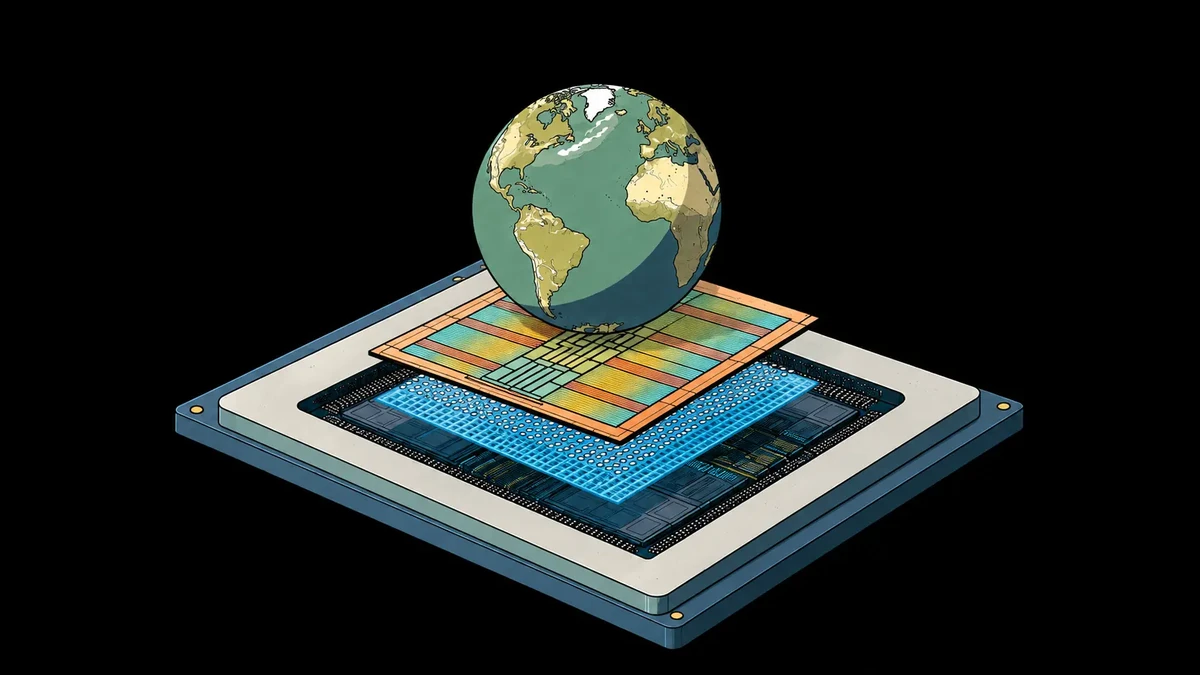
AMD has agreed to acquire World Labs, the spatial-intelligence research company led by Fei-Fei Li, in an all-stock transaction valued at approximately $8.2 billion.
AMD says the acquisition is intended to connect World Labs’ model research with its future hardware, software and system planning. World Labs develops models for spatial reasoning, simulation and robotics, and AMD expects that work to give its engineers a closer view of how emerging AI workloads are changing.
The merger agreement was signed on 26 September 2026 and announced on 28 September 2026. AMD expects the transaction to close by the end of 2026, subject to regulatory approval and other customary conditions. After closing, Li will join AMD as executive vice president and chief scientist, reporting directly to CEO Lisa Su.
AMD wants model research to feed into compute planning
AMD and World Labs were already working together before the acquisition agreement. World Labs says the relationship began in 2025 with model training and inference optimization on AMD GPUs, then expanded as the teams worked across hardware, software, foundation models and applications.
AMD says AI infrastructure will have to support a wider range of workloads as reasoning, robotics, simulation and physical AI develop. The company expects World Labs to provide earlier visibility into those requirements and says the research will help shape future technology roadmaps.
World Labs says scaling its research requires getting closer to hardware, while Li has argued for tighter collaboration between model research, systems and compute.
If the transaction closes, researchers developing those workloads would join the same company that builds CPUs, GPUs, networking, software and AI systems. AMD has not connected World Labs to a named Instinct accelerator, Radeon GPU or processor architecture, so there is no evidence yet for attributing a particular future product feature to the deal.
Atlas shows the workloads World Labs is developing
World Labs focuses on spatial intelligence, with research covering systems that can understand, generate, reconstruct and simulate three-dimensional environments from text, images, video and 3D information.
Atlas, introduced in September, is the clearest example. World Labs says the model was pretrained to combine multiple input types into a shared spatial context and can generate environments while preserving their three-dimensional consistency as a scene expands.
- Multimodal spatial context: Atlas can work across text, images, video and 3D inputs in a shared spatial context.
- 3D-consistent generation: it can create and extend environments while preserving their spatial consistency.
- Simulation and robotics: World Labs presents these environments as useful for simulation and robotics workflows.
The company is also developing simulation technology for robotic learning. Virtual environments can be used to train and evaluate machines before they operate in the physical world, putting simulation and robotics alongside creative applications as targets for the research.
AMD says World Labs will give it deeper insight into how emerging workloads are evolving and help shape future technology roadmaps. Its acquisition announcement specifically identifies robotics, simulation and physical AI when explaining why insight from World Labs could influence future infrastructure decisions.
The $8.2 billion price does not equal a fixed share count
AMD’s SEC filing provides transaction details beyond the acquisition announcement.
The companies entered into the merger agreement on 26 September 2026. AMD values the transaction at approximately $8.2 billion and plans to pay World Labs stockholders in AMD common shares, subject to customary adjustments.
The final number of shares has not yet been fixed. According to the filing, the calculation will use AMD’s volume-weighted average share price over ten consecutive trading days ending on the second trading day immediately before closing.
The $8.2 billion figure is therefore the approximate transaction value rather than a currently fixed number of AMD shares. AMD continues to target completion by the end of 2026 if the required approvals and other closing conditions are satisfied.
World Labs plans to continue model research inside AMD after closing
World Labs says its research work will continue after the acquisition closes. Li will become AMD’s chief scientist, while co-founders Justin Johnson and Ben Mildenhall will continue leading the World Labs team with her.
If the acquisition closes, the research group itself would move inside AMD rather than remaining only an external licensing or hardware-support partner. Li will report directly to Su, giving the model-development team a direct connection to AMD’s broader AI strategy and engineering organization.
NVIDIA’s proposed Hugging Face acquisition targets a different part of AI development: World Labs creates models and spatial-computing workloads, while Hugging Face operates a large developer platform for distributing, adapting and deploying models.
The next useful evidence will come after AMD completes the transaction. The company has said World Labs research will help shape its technology roadmaps, but any effect on specific software, systems or processors will need to be established from later product decisions.
At announcement, the concrete commitment is the agreement itself: if the transaction closes, World Labs would join AMD and Fei-Fei Li would become the chipmaker’s chief scientist. AMD values the all-stock transaction at approximately $8.2 billion.
Sources: AMD acquisition announcement; AMD Form 8-K; World Labs acquisition announcement; World Labs Atlas documentation.