
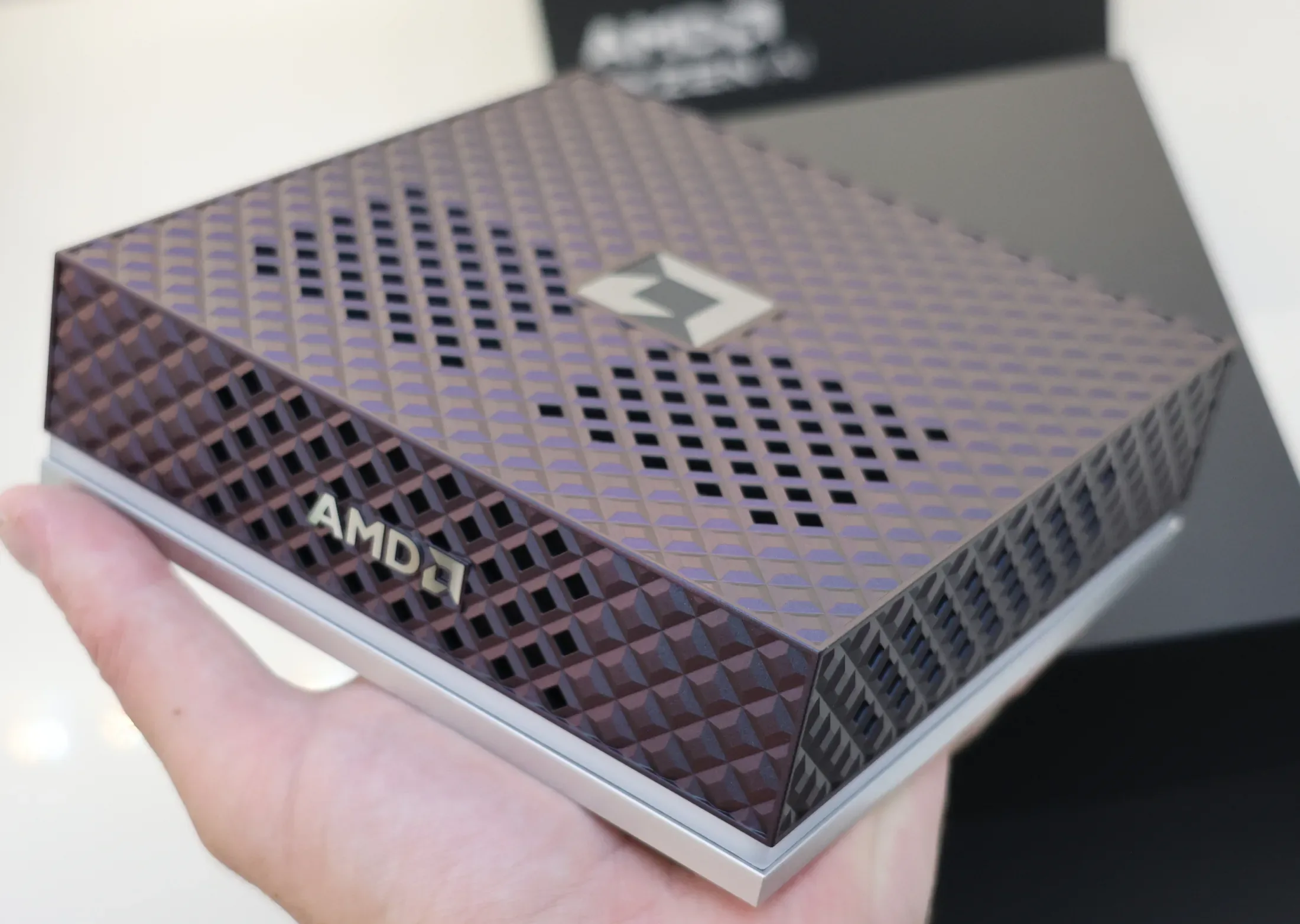
AMD’s Ryzen AI Halo mini PC is now shipping after pre-orders opened last month, bringing the company’s Ryzen AI Max+ 395 “Strix Halo” platform into a compact system aimed at local AI work and high-end integrated graphics use. The headline spec is the 128GB of unified memory, which gives the machine enough headroom to run very large local models, including workloads that can reach up to 200 billion parameters in supported setups.
For PC buyers, the practical takeaway is straightforward: this is not a general office mini PC with a fast APU attached. It is a small x86 system built around a high-power SoC, a large memory pool, and a storage and I/O mix that makes sense for developers, AI users, and anyone who wants a compact machine with far more GPU capability than typical integrated graphics hardware.
Ryzen AI Max+ 395 and Radeon 8060S define the hardware target
The shipping model uses AMD’s Ryzen AI Max+ 395, a chip with sixteen Zen 5 CPU cores and Radeon 8060S graphics. That combination is the core of the Ryzen AI Halo’s appeal. The CPU side gives it enough multi-threaded throughput for demanding desktop and development tasks, while the integrated Radeon graphics are positioned well above the level usually associated with mini PCs.
AMD is also planning a version based on the Ryzen AI Max 400 series “Gorgon Halo,” but the unit going on sale now is the Strix Halo configuration. That matters because buyers are not getting a placeholder or lower-spec launch model. The current system is the full 395-based version with the larger memory configuration and the same platform that has drawn attention for its balance of CPU performance, graphics capability, and power efficiency.
128GB of unified memory changes the local AI use case
The most important specification for the intended audience is the 128GB of LPDDR5x-8000MT/s unified memory. In a mini PC, that amount of memory is unusual, and it is what makes the Ryzen AI Halo relevant for local inferencing and development work. AMD says the system can support up to 200 billion parameter large language models, which places it in a very different category from mainstream consumer desktops and small-form-factor PCs.
Unified memory also changes how the system can be used. Instead of treating system RAM and graphics memory as separate pools, the platform can allocate from a shared high-capacity memory space. For AI workloads, that can simplify model handling and reduce the constraints that usually come with smaller VRAM allocations on discrete consumer GPUs. The exact performance will still depend on the workload and software stack, but the memory capacity itself is the key enabler here.
Linux shipping on the device uses AMD’s Debian-derived developer platform
The Ryzen AI Halo can run either Windows 11 or Linux, which broadens its appeal beyond standard consumer mini PCs. On the Linux side, the shipping software is AMD’s Debian-derived Ryzen AI Developer Platform operating system rather than a basic Ubuntu install with a minimal ROCm setup. That is a meaningful distinction for anyone evaluating the machine for development or AI experimentation, because the software layer is part of the product’s value proposition, not just an afterthought.
The device’s software support also reflects AMD’s push to make the platform usable out of the box for local AI work. For buyers who want a compact machine that can be deployed in Windows or Linux environments, that flexibility is a practical advantage. It also makes the Ryzen AI Halo easier to place in mixed workflows where one machine may need to handle desktop use, model testing, and general compute tasks.
Compact chassis, 120W TDP, and limited display outputs
Physically, the Ryzen AI Halo is small even by mini PC standards, measuring 150 x 150 x 45 mm and weighing under 1.2 kilograms. AMD rates the device at 120 watts TDP, which helps explain how the platform can deliver this level of performance in such a small enclosure. The design is still compact enough to fit where a full desktop would be impractical, but it is clearly built for more than low-power browsing or media playback.
The port selection is functional, though not perfect. AMD includes three USB-C ports, USB-C power delivery, 10 Gbps Ethernet, WiFi 7, Bluetooth 5.4, and one HDMI 2.1b output. There is no dedicated DisplayPort output, which is a limitation for some multi-monitor setups, although USB-C to DisplayPort adapters do work. Storage is handled by a 2TB PCIe Gen5 NVMe SSD, which should suit large local datasets and model files better than the smaller drives often found in compact systems.
For users comparing this to NVIDIA’s DGX Spark or GB10-class systems, the Ryzen AI Halo is positioned as a competitive alternative in a similarly compact form factor. The broader point is that AMD is now shipping a mini PC that combines serious memory capacity, modern connectivity, and a Linux-friendly software story in a package that remains small enough for desk use rather than rack-style deployment.