
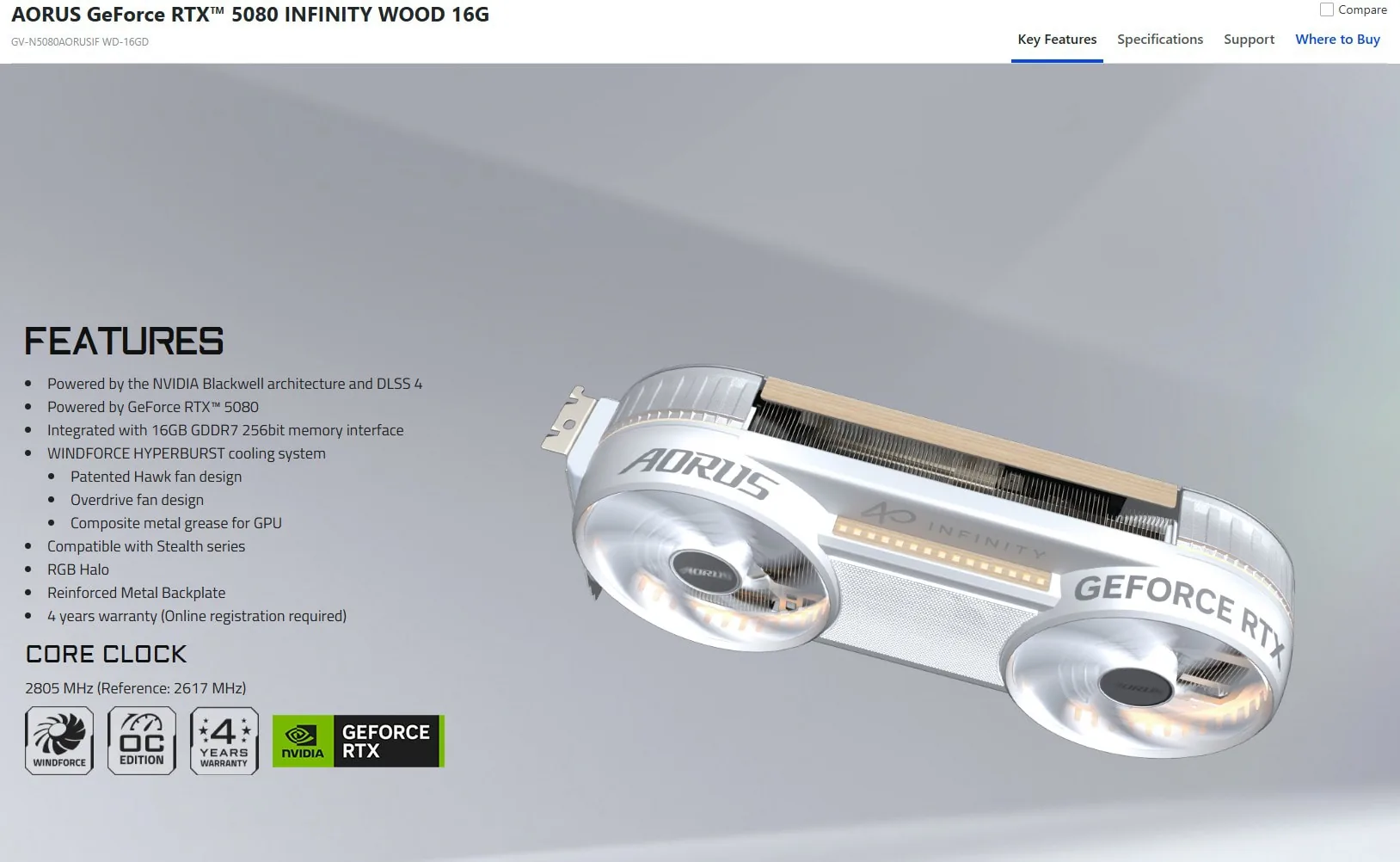
GIGABYTE has expanded its AORUS Infinity graphics card family with three new GeForce RTX 50-series models. The new lineup includes two RTX 5080 variants and one RTX 5070 Ti, extending a series that began with the flagship RTX 5090 AORUS Infinity, first shown at CES 2026 and later released in May.
What changed in the AORUS Infinity lineup
The latest launch brings the AORUS Infinity design to a wider set of GPUs. Until now, the series was centered on the top-end RTX 5090 model. With this update, GIGABYTE is adding an RTX 5080 AORUS Infinity Wood, a standard RTX 5080 AORUS Infinity, and an RTX 5070 Ti AORUS Infinity.
The RTX 5080 AORUS Infinity Wood had already been shown earlier in June at Computex, but it is now being formally launched. The other two cards are also listed on GIGABYTE’s website, although detailed product images have not been published yet.
All three cards use GIGABYTE’s interpretation of NVIDIA’s dual flow-through cooler layout seen on the RTX 50-series Founders Edition cards. In this design, the GPU, memory, and VRM sit in a central PCB area, while breakout boards handle power, display output, and potentially the PCIe interface.
Cooling design is the main AORUS Infinity difference
GIGABYTE says the new cards use its WindForce Hyperburst cooling solution. The system is based on a dual flow-through structure and includes thick axial fans, a fan overdrive mode, and a composite metal thermal interface material for the GPU.
The RTX 5080 AORUS Infinity Wood stands out visually from the rest of the family. It uses a matte white and beige two-tone shroud and adds a real wood trim along the top edge. GIGABYTE positions it as a match for its Aero Wood motherboard line, including boards such as the X870E Aero X3D Wood.
The standard RTX 5080 AORUS Infinity uses a more conventional finish and looks very close to the RTX 5090 AORUS Infinity. GIGABYTE notes that it should be lighter than the RTX 5090 version because the RTX 5080 has lower cooling and PCB requirements.
The RTX 5070 Ti AORUS Infinity shares the same visual design as the RTX 5080 AORUS Infinity. That is possible because the RTX 5070 Ti is also based on GB203 silicon, although it uses the slower GPU configuration and lower memory speeds.
- RTX 5080 AORUS Infinity Wood: 2805 MHz factory boost, compared with 2617 MHz reference
- RTX 5080 AORUS Infinity: 2805 MHz factory boost, same as the Wood model
- RTX 5070 Ti AORUS Infinity: 2670 MHz factory boost, compared with 2452 MHz reference
GIGABYTE is also using the AORUS Infinity series to showcase a more modular internal layout, with the central placement of the main components helping support the flow-through cooling approach.
Which builds these AORUS Infinity cards target
The new models are aimed at buyers who want high-end GeForce RTX 50-series performance in a premium custom design. The RTX 5080 cards sit below the RTX 5090 in the stack, while the RTX 5070 Ti version offers a lower-cost entry into the same AORUS Infinity styling and cooling concept.
The wood-trimmed RTX 5080 is the most distinctive option for users building a system around matching aesthetics. It is especially relevant for PC builders who already use GIGABYTE’s Aero Wood motherboards or want a more coordinated white-and-wood theme.
The standard RTX 5080 AORUS Infinity is the more traditional choice for users who want the same cooler architecture and factory overclock without the wood styling. The RTX 5070 Ti AORUS Infinity is the option for buyers who want the same design language but do not need the higher GPU tier.
Availability and product-line context
GIGABYTE has not provided detailed pricing or a full retail availability breakdown for the three cards in the announcement. The company’s product pages are already live, which suggests the launch is underway, but no additional launch timing was given in the information available.
For buyers, the key points are the factory overclocks, the new WindForce Hyperburst cooling system, and the expansion of the AORUS Infinity design beyond the RTX 5090. The RTX 5080 Wood model also adds a more specific aesthetic option for system builders who want hardware that matches the rest of their platform.
Source: TechPowerUp