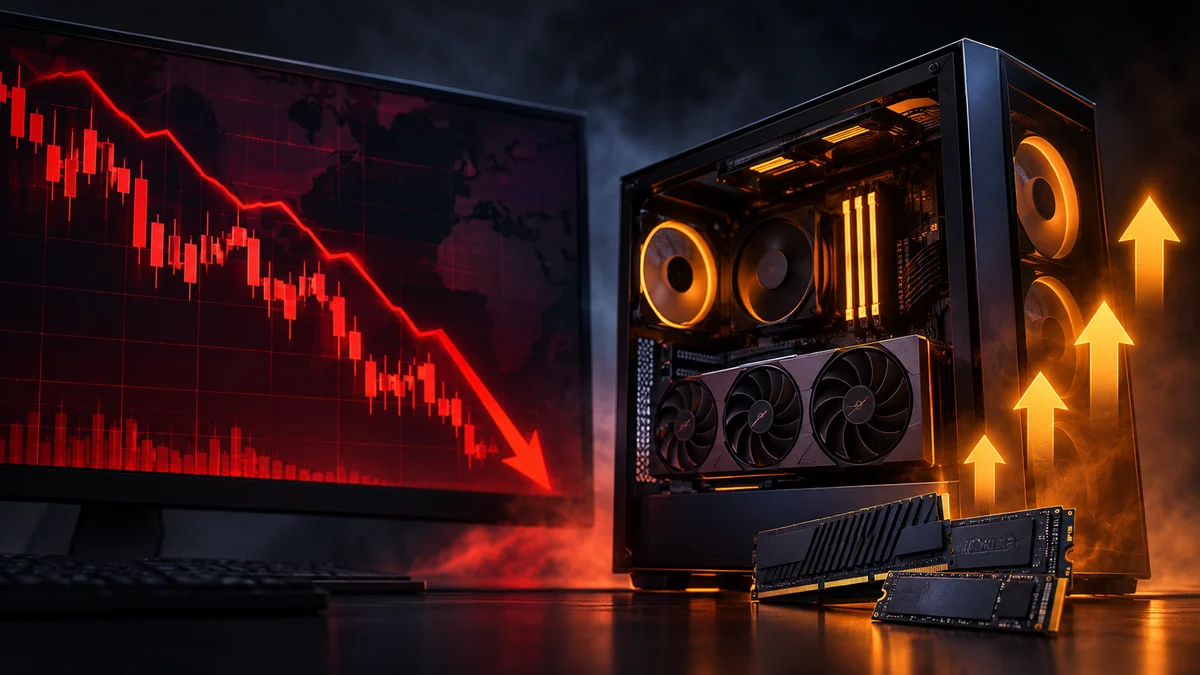
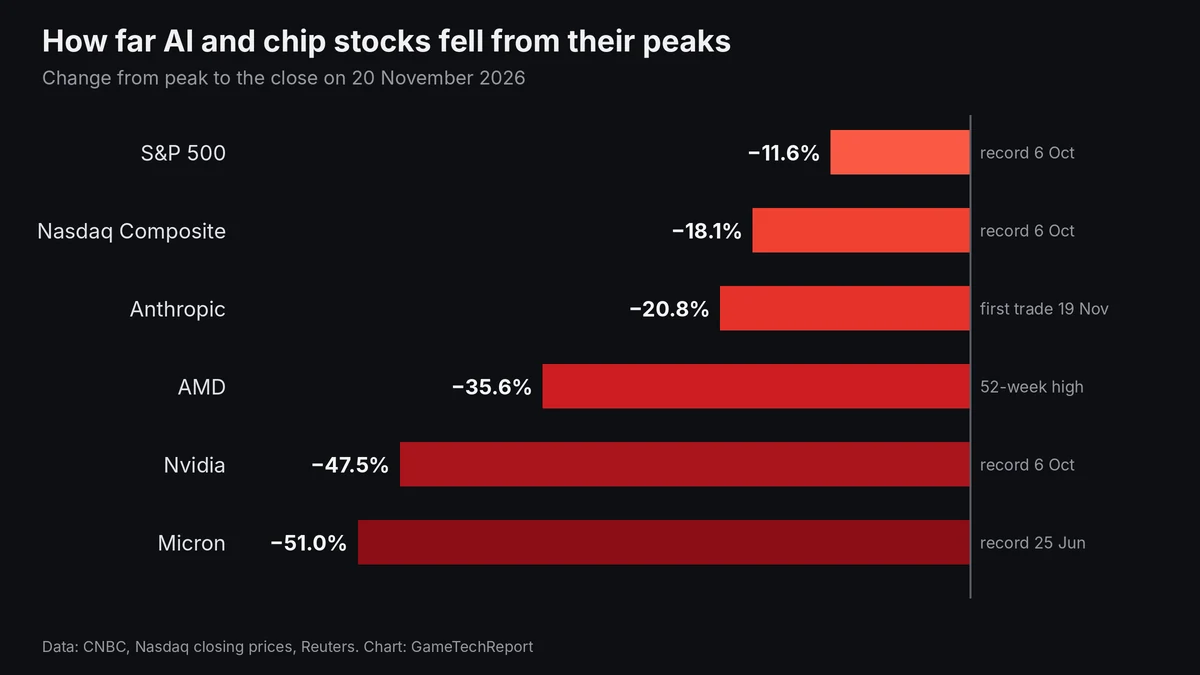
AI and chip stocks have lost trillions of dollars in market value since early October, and Anthropic’s record IPO on 19 November did not slow the slide. On 20 November the Nasdaq Composite closed 18% below its 6 October record, Nvidia was worth about $2.7 trillion less than at its October peak, and Micron and AMD fell about 14% and 13% in a single session. The AI stock crash has not lowered hardware prices for graphics cards, RAM or SSDs. Memory and GPU prices kept rising through November. Only wholesale spot prices for NAND flash, the memory chips inside SSDs, have started to fall, and store prices for SSDs have not caught up yet.
Anthropic’s IPO and the two-day sell-off
Anthropic sold 1.127 billion shares at $83 in the largest IPO on record, raising about $93.5 billion before fees, of which about $91.6 billion went to the company, according to its closing announcement. A separate private placement added $26 billion. The first trade on Nasdaq came at $111.50, 34% above the offer price, and the stock closed the day at $97.17. On 20 November it closed at $88.32, 6% above the IPO price and 21% below the first trade.
The Nasdaq fell 2.25% on 19 November and 5.3% on 20 November, wiping out its gain for 2026. The S&P 500 fell for a seventh straight session, its longest losing streak since February 2020, and closed more than 10% below its record, which counts as a correction. Chipmakers led the losses, with Nvidia, Micron, Broadcom and AMD all down by double digits. The slide started long before the IPO. Yahoo Finance counted about $5 trillion in market value lost across 47 AI and chip stocks in the three weeks after 6 October. The PHLX Semiconductor Index fell more than 9% on 20 November and is over 40% below its June record. Bitcoin dropped below $59,000 the same day, its lowest level since July and more than 53% below its October 2025 record of $126,198.
| Market | Peak | Close, 20 November | From peak |
|---|---|---|---|
| S&P 500 | 7,818.93 (6 October) | 6,910.39 | −11.6% |
| Nasdaq Composite | 27,599.79 (6 October) | 22,617.73 | −18.1% |
| Nvidia | $239.24 (6 October) | $125.53 | −47.5% |
| AMD | $658.52 (52-week high, early October) | $424.39 | −35.6% |
| Micron | $1,213.56 (25 June) | $594.51 | −51.0% |
| Anthropic | $111.50 (first trade, 19 November) | $88.32 | −20.8% |
Nvidia’s results and what is driving the sell-off
Nvidia reported third-quarter revenue of $115.8 billion on 17 November, up 103% from a year earlier, and guided the current quarter to $130 billion. The stock fell anyway, and on 20 November it dropped 14% more after Reuters reported that SEC enforcement staff are examining potential accounting issues at the company. An SEC inquiry is not a finding of wrongdoing. Jensen Huang resigned as chief executive on 11 November, with chief financial officer Colette Kress named interim CEO, as Nvidia’s filing with the SEC shows. In the days that followed, Washington tightened export rules on AI chips routed through third countries, short sellers published reports on Nvidia’s and AMD’s sales into China, and the 10-year US Treasury yield held near 5%.
Data centers brought in $107.6 billion of Nvidia’s quarter, or 93% of revenue. Edge computing, the segment Nvidia now reports for PCs, gaming, cars and robots, made $8.2 billion. With 13 times more revenue coming from servers, the server business has the stronger claim on Nvidia’s memory and wafer supply, and a lower share price does not change that.
PC part prices in November 2026
DDR5 memory in Germany cost 8.6% more in November than in October, and graphics cards 8.5% more, according to 3DCenter’s price index, based on prices collected on 15 November. The 20 DDR5 kits it tracks now cost just over six times their July 2025 level.
| Item | Before | Now | Change |
|---|---|---|---|
| Cheapest 2x16GB DDR5-6000 kit, Germany | €75 (July 2025) | €468 (November 2026) | +524% |
| Same kit | €447 (October) | €468 (November) | +5% |
| DDR5 average, 20 kits, Germany | October | November | +8.6% |
| Graphics cards average, Germany | October | November | +8.5% |
| DRAM contract prices | End of 2025 | Q4 2026 forecast | About 4x |
| NAND flash spot prices | Early November | Mid-November | −20% |
| GeForce RTX 5070, US | $549 (MSRP) | About $900 | +64% |
| GeForce RTX 5080, US | $999 (MSRP) | About $2,200 | +120% |
Contract prices, which chipmakers negotiate each quarter with PC makers and cloud companies, set the direction for everything else. TrendForce expects PC DRAM contracts to rise another 13% to 18% in the fourth quarter and general DRAM 5% to 10% in the first quarter of 2027. Micron’s chief technology officer told CNBC on 18 November that memory supply in 2027 will be tighter than in 2026. Retail prices follow contracts with a delay of weeks to months, because stores sell stock bought at earlier prices.
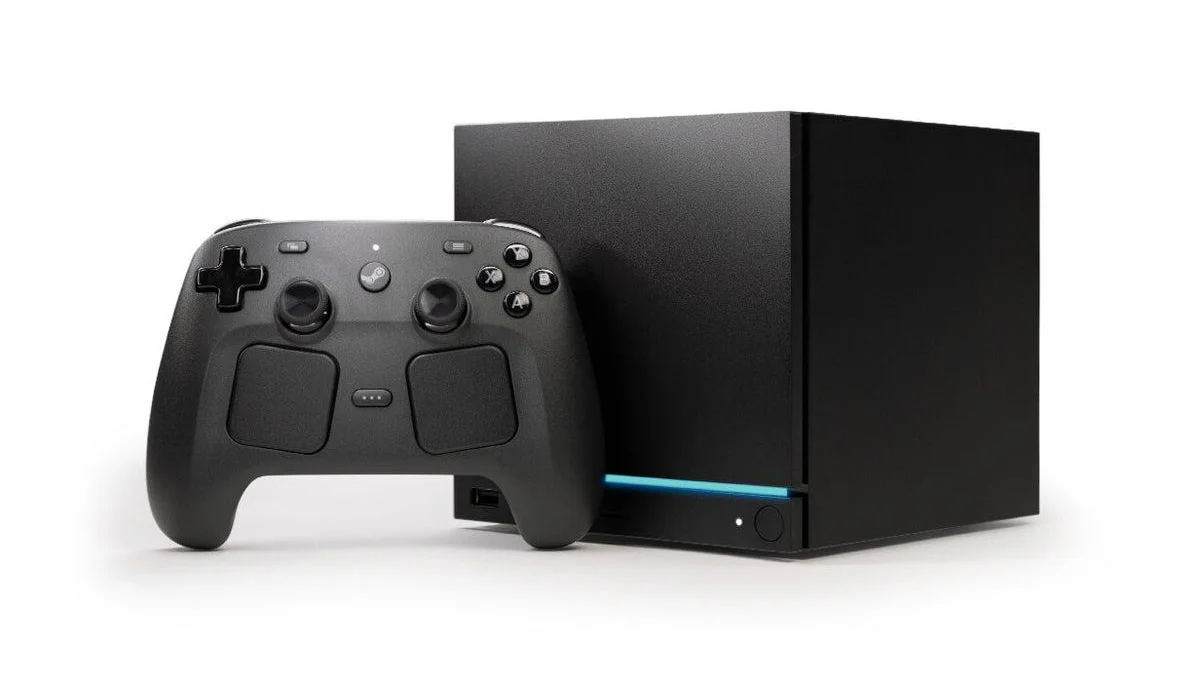
Graphics cards depend on the same memory. In the US the RTX 5070 sells for 64% above its $549 MSRP and the RTX 5080 for 120% above its $999 MSRP, according to TechSpot’s Q4 pricing update, and board partners raised RTX 50 prices again in September. The Steam Machine went on sale at $1,049 for the 512GB model after Valve said its original price goal was no longer viable because of memory costs. On 19 November Valve said that memory and storage costs are still rising and that it cannot yet say how many more Steam Machines it will build or at what price. New buyers can order the 512GB model without a reservation while stock lasts, and the 2TB waitlist is closed.
SSD prices: NAND flash is already falling
NAND flash spot prices fell 20% in two weeks in November, as smartphone and PC makers cut orders and traders in China cleared stock, TrendForce reported. It cut its fourth-quarter NAND contract forecast to +8% to 13% and expects NAND contract prices to start falling in the second quarter of 2027. Enterprise SSDs for AI servers are still forecast to rise 15% to 20% in the fourth quarter, so any relief reaches consumer drives first. Shelf prices will lag behind both, because drives already in stores were built with flash bought at earlier prices. Our earlier report on memory prices covers how the AI build-out pushed them up.
| Part | Direction now | What would bring prices down | Earliest relief on current forecasts |
|---|---|---|---|
| SSDs | Spot falling, contracts slowing | Consumer NAND contracts turning lower | Second quarter of 2027, for contracts |
| RAM | Still rising | Lower AI server orders, DRAM spot falling | No fall forecast yet |
| Graphics cards | Still rising | Cheaper graphics memory and more supply for GeForce | After RAM |
| Steam Machine | Price of future units unknown | Lower memory and storage costs | No date from Valve |
The 2022 crypto crash and GPU prices
Graphics card prices last fell sharply after the crypto crash of 2022. Tom’s Hardware tracked drops of 10% to 15% a month through the spring, and by late summer 3DCenter had RTX 30 cards in Europe selling 9% below MSRP, the better part of a year after Bitcoin’s November 2021 peak. Mining had stopped paying, so miners stopped buying cards and started selling used ones.
The buyers behind current prices are AI data centers, and they are still ordering. Nvidia’s $130 billion forecast for the quarter ending in January rests mostly on them, and Micron expects demand to outrun memory supply through 2027.
What gamers and investors should watch
For a PC build or upgrade, SSDs are the part most likely to get cheaper in the next few months, since NAND spot prices are already falling. Current forecasts show no broad price drop for RAM or graphics cards in the coming months, and Black Friday deals on them start from November’s higher prices. A build that needs RAM or a graphics card now has little reason to wait for a market-wide drop, while an SSD upgrade that is not urgent can wait.
Three signals would change that: cloud companies cutting capital spending in their results from late January, DRAM spot prices following NAND down, and TrendForce lowering its forecasts for the first half of 2027. If they arrive, memory and GPU prices would follow within a few quarters, as they did in 2022.