
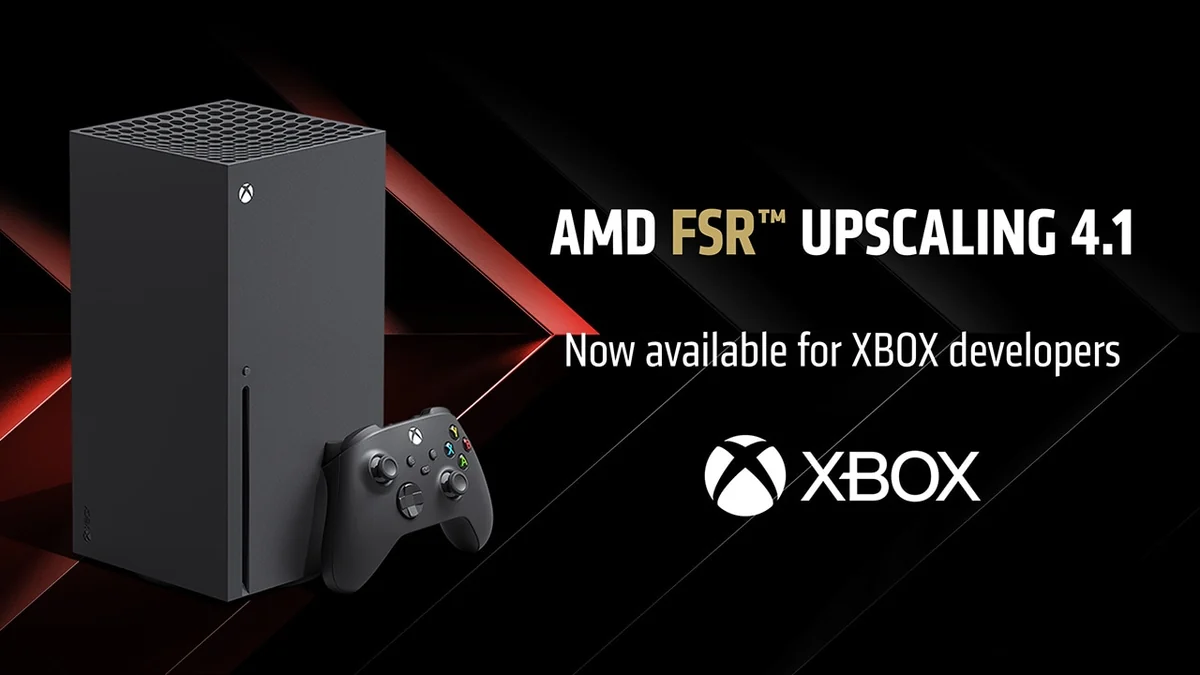
AMD’s machine-learning upscaler has reached Xbox Series X|S, but only on the developer side for now. FSR Upscaling 4.1.2 ships with the October 2026 Microsoft Game Development Kit, which AMD and Microsoft announced on 4 November. It is the first time an ML version of FSR has been available for Xbox consoles, about two weeks after AMD said on 20 October that it was on the way. Studios now have to build it into their games, and so far no title has been named.
Two models, and both run on Series X and Series S
The Xbox release includes a Full INT8 model and a Lite INT8 model. AMD says Lite is less than half the size of Full and cheaper to run, and studios choose which one to use. A new GDK sample switches between Full, Lite and the older FSR 3 at runtime, so developers can compare image quality and cost in the same scene.
Choosing Lite saves GPU time, not memory. According to AMD, the upscaler’s memory use depends on the render and output resolution, so it is the same for both models.
Both models are INT8 because of the hardware. Series X and Series S use RDNA 2 graphics without FP8 support, so they run integer models, as Radeon RX 6000 cards have done since AMD’s FSR SDK 2.4 in October. Radeon RX 9000 cards run FSR 4 in FP8.
FSR 4 takes 1.3 to 5.2 ms of each frame
Microsoft published GPU time for both models on both consoles, measured in the GDK sample. Each figure is the GPU time of the upscaling pass at the given output resolution. The percentage in brackets is our calculation: the share of a 16.7 ms frame, which is all the time a game has at 60 FPS.
| Console | Output | Lite model | Full model |
|---|---|---|---|
| Series X | 1440p | 1.29 ms (8%) | 1.95 ms (12%) |
| Series X | 4K | 2.75 ms (17%) | 3.86 ms (23%) |
| Series S | 1080p | 1.9 ms (11%) | 2.9 ms (17%) |
| Series S | 1440p | 3.4 ms (20%) | 5.2 ms (31%) |
Microsoft lists only the output resolution, not the render resolution, quality mode or test scene, so the table shows scale rather than what any particular game will get. The trade-off is still clear. On Series X, Full at 4K takes almost a quarter of a 60 FPS frame. On Series S, Full at 1440p takes close to a third. A Series S game aiming for 60 FPS is likely to reach for Lite, a 1080p output, or both. At 30 FPS the same 5.2 ms is about 16% of a 33.3 ms frame, which leaves far more room.
The upscaler only pays off when the game renders fewer pixels to begin with. FSR 4 starts from a lower internal resolution and rebuilds a sharper image than older methods manage. Whether a game ends up faster, sharper or both depends on how much resolution it gives up to cover those milliseconds.
PlayStation got there first
Sony took the same route on the standard PS5 with QSSR, a performance-focused ML upscaler for the 2020 console, and it is already in shipping games: Marvel’s Wolverine and Ghost of Yōtei. In Digital Foundry’s Wolverine test, QSSR added about 1.5 to 1.8 ms over the game’s previous upscaler at a 1440p output.
The two sets of figures measure different things. Digital Foundry timed the extra frame cost in a finished game, while Microsoft timed the upscaling pass in a sample. The order of magnitude is similar, though: on PS5 and Series X alike, ML upscaling to 1440p lands somewhere around 1.3 to 2 ms. For now, the real gap is adoption. PS5 owners already have QSSR in two games. Xbox owners have a tool their developers can start using.
Frame generation, handhelds and Project Helix
- Upscaling only. Neither AMD nor Microsoft lists frame generation in the Xbox release. On PC, AMD’s ML frame generation still requires a Radeon RX 9000 card.
- Existing Xbox games stay as they are. FSR 4 arrives only through a game update or a new release that integrates it, and nothing announced so far ties it to a specific game, GTA 6 included.
- ROG Xbox Ally handhelds take a different path. They run Windows and use the standard FSR SDK. An ASUS preview driver for the Ally X and X20 can upgrade DirectX 12 games that use FSR 3.1 or newer, and support for the base ROG Xbox Ally is due in a later update.
- Next-generation Xbox is a separate track. Microsoft has said Project Helix will use a newer AMD stack called FSR Diamond. FSR 4.1.2 is for the Series X|S consoles people already own.
- PC could benefit indirectly. The Xbox version uses the same FSR SDK API as Windows, so a studio that adds FSR 4 for Xbox has already done much of the work needed on PC.
Sources: AMD GPUOpen, “AMD FSR Upscaling 4.1.2 Comes to XBOX” and Microsoft Game Dev, “AMD FSR Upscaling 4 Is Now Available for XBOX”, both 4 November 2026. The QSSR figures come from Digital Foundry’s testing, covered in our PS5 QSSR article. The frame-budget percentages are GTR’s calculation.