
ChatGPT Ads has reached a $1 billion annualized revenue run rate less than 200 days after launch, as OpenAI expands self-service ad buying beyond the United States. The company says tens of thousands of advertisers are now using the platform and that ChatGPT has more than one billion weekly active users.
Annualized run rate is a snapshot of the business at its current pace. At $1 billion, that works out to roughly $83 million a month, not $1 billion already collected this year. The pace has changed sharply since the US pilot began.
The August run rate is roughly 10 times April’s checkpoint
OpenAI began testing ads with users in the United States earlier this year. Reuters reported that the US pilot had crossed $100 million in annualized revenue within six weeks by April. The August run rate is roughly ten times that early checkpoint. Both figures describe the pace of the business at those dates; neither is a cumulative revenue total.
OpenAI now lists advertising alongside consumer subscriptions, enterprise products and usage-based API access as one of its revenue pillars. Small and medium-sized businesses already represent what the company calls a material share of the ads business, a sign that buying is moving beyond a limited set of managed campaigns.
Reuters also notes that OpenAI has targeted $2.5 billion in advertising revenue for 2026. eMarketer analyst Nate Elliott argued that the August pace leaves that target looking difficult despite the speed of the early ramp.
Ads Manager has opened the door to smaller advertisers
OpenAI introduced a beta version of Ads Manager in May, giving advertisers a way to create and manage campaigns without relying entirely on OpenAI’s sales team or an agency. The platform now supports CPC and outcome-optimized bidding, product feeds, geographic and platform targeting, custom audiences, and measurement through OpenAI’s Pixel and Conversions API.
That toolset is now much closer to what advertisers expect from a conventional ad platform. OpenAI says its ecosystem has grown to more than 50 technology and measurement partners, while tens of thousands of advertisers are active. No revenue breakdown by advertiser size is public, and the available campaign data is too limited to establish a typical return on ad spend.
OpenAI points to two performance examples: an ecommerce advertiser that generated a 3x return on ad spend over 28 days, and a technology partner that found more than 80% of ChatGPT ad-driven traffic came from new customers. Without broader campaign data, those examples do not show what a typical advertiser is seeing.
Self-service buying expands across Europe, India and MENA
OpenAI says ChatGPT Ads is now available in more than 40 countries through its own sales organization and partners. From August 31, advertisers across Europe, India, the Middle East and North Africa can also use Ads Manager directly.
Earlier in August, OpenAI expanded ad availability to 31 European markets through sales, agency and technology partners. The August 31 self-service launch lets eligible advertisers in those markets build and manage campaigns directly through Ads Manager.
Advertisers outside the United States now represent a growing share of revenue, according to OpenAI, but no regional revenue split is public. Its next phase includes more markets, ad formats, campaign objectives, buying options and measurement features. The $1 billion run rate gives that expansion an early benchmark for later updates.
ChatGPT context can shape which ads appear
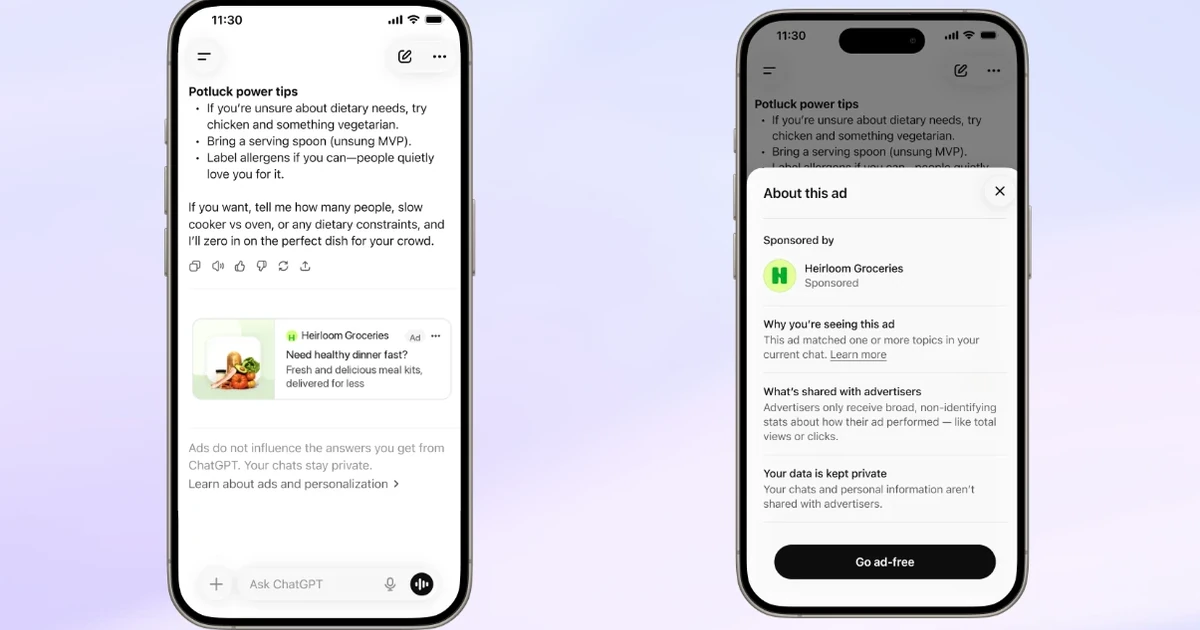
OpenAI pairs the expansion with explicit rules for how ad targeting works inside ChatGPT. The company says advertisements are clearly labeled, displayed separately from ChatGPT’s answers and do not influence the answers the assistant provides. It also says advertisers do not receive access to users’ private conversations.
OpenAI says the current conversation can be used to choose a relevant advertisement and, depending on country and user settings, broader ChatGPT context may also contribute to ad relevance. The matching happens inside ChatGPT. Advertisers receive aggregated reporting such as views and clicks, while OpenAI says they do not get private chats, chat history, memories or personal data.
ChatGPT Ads is already operating as a self-service international ad platform less than 200 days after launch. The next useful checkpoints will be whether its current revenue pace holds as OpenAI adds more markets and formats, and how the company develops the boundary between conversational context, ad targeting and advertiser access.
Sources: OpenAI; Reuters; Digiday; OpenAI Help Center.