
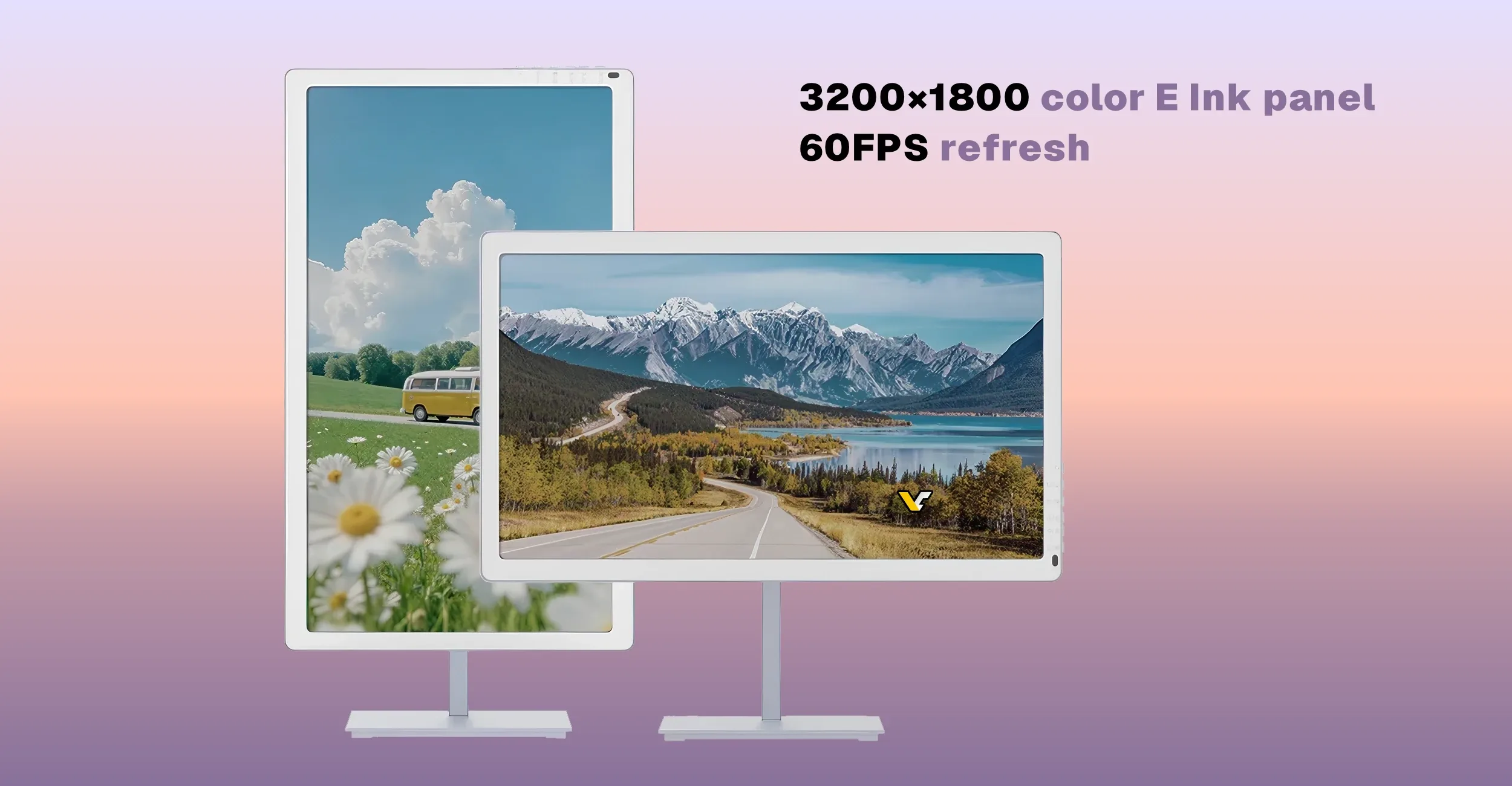
Bigme has introduced the B251 PRO, a 25.3-inch color E Ink monitor built around a Kaleido 3 panel and listed at $1,279. The company is positioning it as a high-refresh E Ink display, with a claimed target of up to 60FPS, but the practical appeal remains tied to text-heavy work rather than mainstream gaming or fast-motion content.
The panel uses a 3200×1800 resolution, 4,096 colors, 16 grayscale levels and a 145 PPI pixel density. Those numbers matter because they define the monitor’s core trade-off: it offers a large, paper-like canvas with color support, but it is still operating within the limits of E Ink technology rather than conventional LCD or OLED behavior.
Bigme B251 PRO uses a 25.3-inch Kaleido 3 color E Ink panel
The B251 PRO’s headline feature is its 25.3-inch Kaleido 3 display. Bigme says the monitor supports up to 60FPS refresh, which is the company’s main differentiator for this model. That claim should be read carefully, though, because E Ink panels do not behave like standard gaming monitors when it comes to pixel response or motion handling.
Bigme also includes adjustable warm and cold front lighting. That makes the display more flexible for reading and office use in different lighting conditions, especially if the monitor is being used for long sessions where eye comfort matters more than color accuracy or motion clarity.
For buyers comparing it with other large E Ink displays, the size class is not new. DASUNG already offers a 25.3-inch Paperlike Color model, and BOOX has the Mira Pro Color in the same general category. Bigme’s distinction is the refresh target it is advertising, not the panel size itself.
3200×1800 resolution and 4,096 colors set the practical ceiling
The B251 PRO’s 3200×1800 resolution gives it enough pixel density for text and interface work on a large desktop panel, but the color output remains limited compared with conventional monitors. Bigme lists 4,096 colors and 16 grayscale levels, which is useful for documents, coding, and static content, but it is not the same as the broader color performance buyers get from LCD or OLED panels.
That limitation matters more than the raw resolution when the screen is used for mixed media. E Ink displays can look excellent for reading and low-motion productivity, but image quality during movement is still constrained by the technology. Even with a higher refresh target, the panel’s response characteristics will shape the actual experience more than the spec sheet headline.
Bigme’s own positioning suggests the B251 PRO is intended for users who want a large display that is easier on the eyes than a conventional backlit monitor, not for people chasing competitive gaming performance.
HDMI and DisplayPort are included, but USB-C is not for display input
Connectivity is straightforward. The B251 PRO includes HDMI and DisplayPort inputs, which should make it compatible with typical desktop PCs and many laptops through the right adapter or dock setup. Bigme also lists a USB-C port, but that port is for firmware upgrades only, not for video input.
That detail is important for buyers planning a clean single-cable setup. If USB-C display input is part of the requirement, this monitor does not appear to offer it. The included remote control and the stand’s tilt and swivel adjustment round out the physical package, but the core connection options remain HDMI and DisplayPort.
- Inputs: HDMI and DisplayPort
- USB-C: firmware upgrades only
- Stand: tilt and swivel adjustment
- Included accessory: remote control
Bigme’s 60FPS claim does not make this a gaming monitor
Bigme is calling the B251 PRO the world’s first 25.3-inch color E Ink monitor with up to 60FPS refresh, but that should not be confused with a conventional gaming display. E Ink still has known limits in pixel response, ghosting and motion image quality. Those constraints are part of the technology itself, and they remain relevant even when a manufacturer raises the advertised refresh target.
In practical terms, the monitor may suit slower-paced games, visual novels or turn-based titles where motion is limited and readability is more important than frame-to-frame clarity. Fast shooters, racing games and action-heavy titles are much more likely to expose the panel’s latency and refresh compromises.
That is why the B251 PRO reads more like a niche productivity display than a replacement for a standard gaming monitor. For buyers who spend most of their time reading, writing or working in static windows, the E Ink format may be attractive. For anyone expecting LCD-like motion handling, the technology gap is still the deciding factor.
The product page lists the monitor at $1,279, down from a stated $1,599 price. Even at the lower figure, this remains a specialized purchase aimed at a narrow use case rather than a general-purpose desktop display.
For readers comparing niche display technology with more traditional gaming panels, Samsung Display has also shown a 360Hz 4K QD-OLED panel with 680Hz FHD dual-mode, which sits at the opposite end of the monitor market.
Sources: Bigme; VideoCardz