
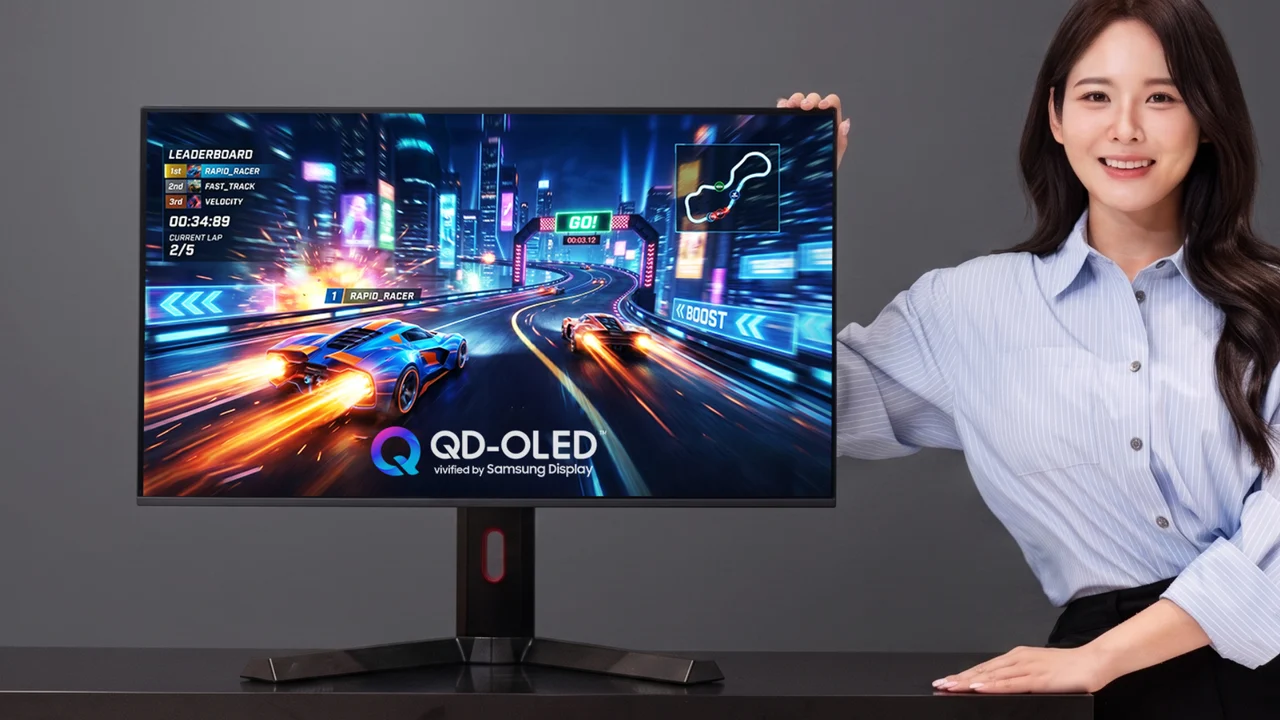
Samsung has moved its 4K 360Hz QD-OLED panel from a Computex technology announcement into the 2027 Odyssey OLED G8. The 32-inch G80SJ monitor uses three operating modes: UHD at 360Hz, QHD at 520Hz and FHD at 680Hz. That gives the original dual-mode panel story a concrete product, while adding a middle setting for players who want more speed without dropping all the way to 1080p.
The G8 uses Samsung’s fifth-generation QD-OLED panel with Penta Tandem technology and an RGB Stripe subpixel layout. Availability will vary by market, and Samsung has not yet announced final launch dates or pricing.
The Odyssey OLED G8 adds a third resolution and refresh mode
Samsung Display’s May panel announcement paired native 4K resolution with 360Hz and offered a 680Hz FHD mode. The finished Odyssey specification expands that into Triple Mode:
- UHD at 360Hz for the highest resolution
- QHD at 520Hz as a middle ground
- FHD at 680Hz for the highest refresh rate
Those modes do not make every game run at the panel’s maximum refresh rate. The connected PC still has to produce enough frames at the selected resolution, and the benefit of moving from an already high refresh rate to 520Hz or 680Hz will be concentrated in competitive titles and sufficiently fast systems.
The practical value is flexibility. A player can retain 4K for visually detailed games, choose QHD for a less severe GPU load, or prioritize motion update frequency at FHD without replacing the display.
Fifth-generation QD-OLED changes more than refresh rate
The 32-inch panel uses Penta Tandem technology and RGB Stripe subpixels. Samsung says the stripe layout improves text clarity by reducing color fringing, addressing an area where subpixel structure can make OLED monitors look less clean in desktop applications.
The G8 is rated for a 0.03ms gray-to-gray response time and VESA DisplayHDR True Black 600. Samsung’s launch notes specify that final DisplayHDR certification is to be completed at product launch, so the badge should be checked again when retail units arrive.
Samsung Glare Free uses a film the company describes as 54% less glossy than a conventional anti-reflection film. The goal is to reduce reflections in brighter rooms without relying on a strongly matte surface.
DisplayPort 2.1, USB-C and adaptive sync round out the product
Connectivity includes DisplayPort 2.1 UHBR20, two HDMI ports, USB-C with up to 98W power delivery, two downstream USB ports and KVM support. That is a more complete workstation configuration than the early panel announcement could establish.
AMD FreeSync Premium Pro and NVIDIA G-SYNC Compatible support are listed, with Samsung again noting that certification is expected to be completed at launch. Buyers should verify which combinations of resolution, refresh rate, color depth and adaptive sync are available over each input in the final manual.
Pricing and market dates are still missing
Samsung says the 2027 Odyssey lineup will have different timing by market, with pricing to be announced later. The company has therefore confirmed the monitor and its main specifications, but not when a buyer in a particular country can order it.
The earlier Samsung Display announcement said mass production of the 31.5-inch panel would begin in the second half of 2026 and that the panel maker was discussing supply with multiple customers. That leaves room for other brands to use related QD-OLED hardware as well as Samsung Electronics’ own G8.
GTR will follow those products in its Hardware section. The immediate change is that 4K 360Hz and FHD 680Hz are no longer only a panel demonstration: they are part of an announced retail monitor design.
Sources: Samsung Display — 4K 360Hz QD-OLED panel; Samsung Global Newsroom — 2027 Odyssey lineup.