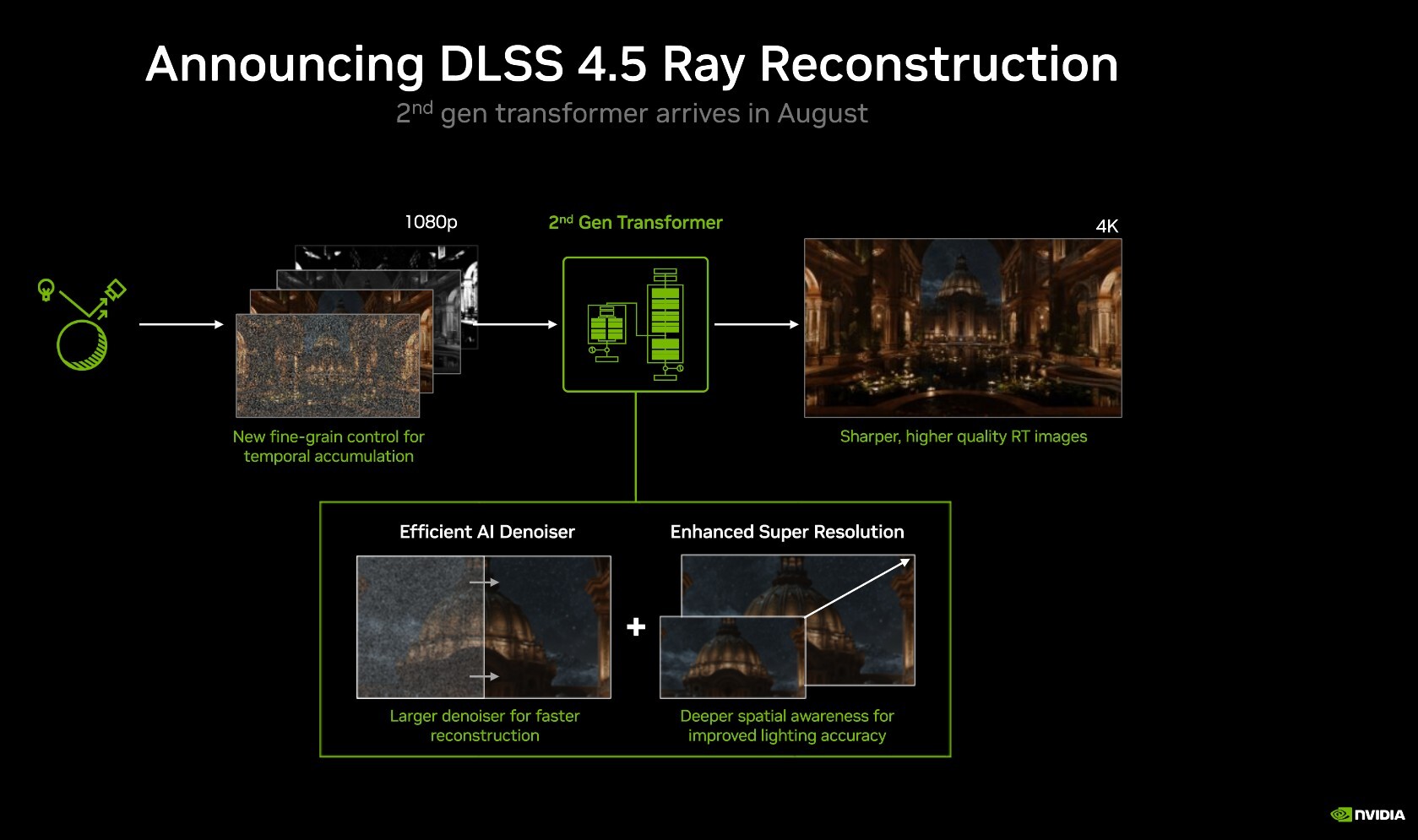
NVIDIA has added a new version of Ray Reconstruction to DLSS 4.5, bringing a second-generation transformer-based model into the package. The update extends a feature first introduced with DLSS 3.5, where Ray Reconstruction was meant to improve the look of ray-traced shadows and reflections that could appear unstable or inaccurate with DLSS upscaling.
What changes with DLSS 4.5
The main change is the move to a newer transformer model trained on a larger set of data. NVIDIA is pairing that with a more efficient AI denoiser and improved spatial awareness to help lighting look more accurate in supported games.
In practical terms, this is meant to refine how ray-traced detail is cleaned up and reconstructed after denoising, rather than changing the core idea behind the feature.
From DLSS 3.5 to the new model
Ray Reconstruction originally arrived as part of DLSS 3.5 in 2023, aimed at fixing a problem that could show up when DLSS 2 super resolution was combined with ray tracing. The earlier implementation used a CNN-based AI model.
NVIDIA later moved that older model to a transformer-based approach in 2025, and DLSS 4.5 now brings Ray Reconstruction in line with the rest of the newer feature set.
Why it matters for image quality
Ray Reconstruction is designed to make ray-traced scenes look cleaner and more stable without relying only on traditional denoising methods. With the updated model, NVIDIA is focusing on:
- better reconstruction of ray-traced shadows and reflections
- more efficient AI denoising
- improved spatial awareness for lighting
- more consistent image quality in supported titles
That makes this less of a headline feature and more of a quality upgrade for players who already use DLSS and ray tracing together.
Part of NVIDIA’s broader DLSS update
DLSS 4.5 now includes the updated Ray Reconstruction feature as part of the broader transformer-based AI model set. NVIDIA did not change the basic purpose of the feature, but the new version is meant to tighten up the visual results in games that rely heavily on ray tracing.
Source
Source: TechPowerUp