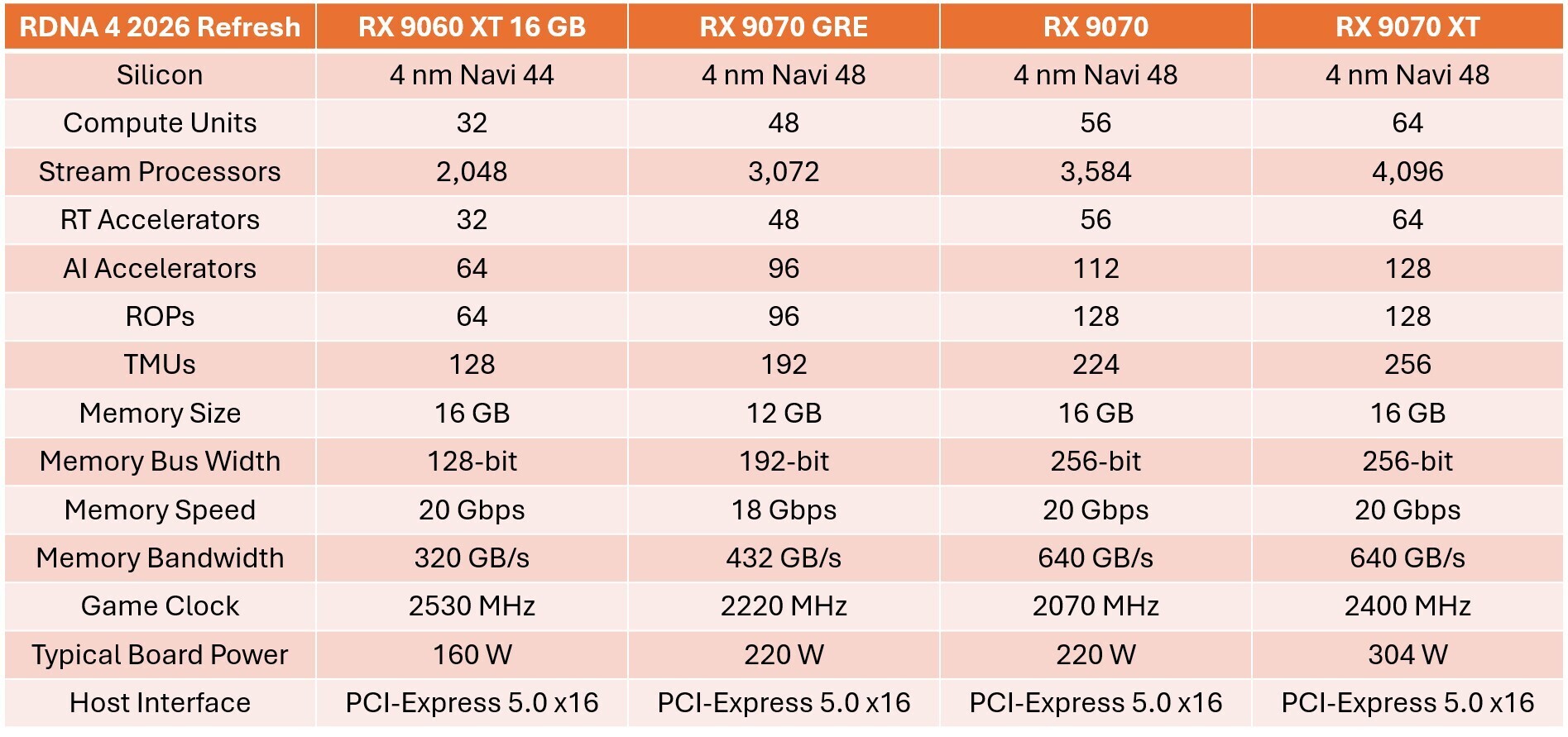
AMD has expanded the Radeon RX 9070 GRE Worldwide at a launch price of $550, moving the card beyond China and into a broader lineup aimed at the gap between the RX 9060 XT 16 GB and the standard RX 9070. The new model sits on the same Navi 48 foundation as the higher-tier RX 9070 and RX 9070 XT, but with a trimmed configuration designed to carve out a distinct middle ground.
A new slot in AMD’s stack
The Radeon RX 9070 GRE was originally introduced as a China-only product, but AMD is now bringing it to a wider market. The idea is straightforward: offer something stronger than the RX 9060 XT 16 GB without jumping all the way to the RX 9070.
That makes it a more clearly positioned option for buyers looking at the crowded space around mainstream and upper-mainstream gaming cards.
What’s inside the RX 9070 GRE
Although it uses the same Navi 48 silicon as the RX 9070 and RX 9070 XT, the GRE is cut down to three quarters of the full chip.
- 48 compute units
- 3,072 stream processors
- 48 RT accelerators
- 96 AI accelerators
- 192 TMUs
- 96 ROPs
- 12 GB of GDDR6 memory
- 192-bit memory bus
- 437 GB/s memory bandwidth
- 48 MB of Infinity Cache
AMD also lists a 2.20 GHz game clock and up to 2.79 GHz boost frequency, with memory running at 18 Gbps.
Positioned against the RTX 5060 Ti 16 GB
AMD is pitching the card directly against NVIDIA’s GeForce RTX 5060 Ti 16 GB, which carries a $570 price tag. In AMD’s own testing, the RX 9070 GRE is said to be 22% faster and to offer 26% better performance per dollar.
AMD is also framing the card as a 1440p-class GPU, while NVIDIA’s RTX 5060 Ti is typically recommended for 1080p gaming.
Availability and board partners
The card is available starting today, June 1, through AMD’s add-in board partners. The launch list includes:
- Sapphire
- PowerColor
- ASRock
- XFX
- GIGABYTE
- Acer
- ASUS
Source
Source: TechPowerUp