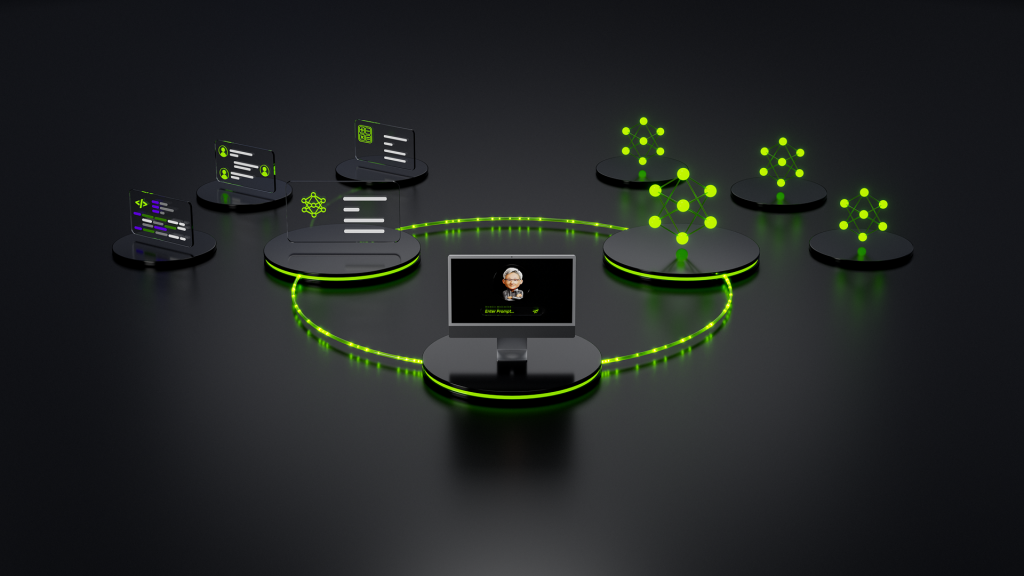
NVIDIA has published a practical guide to customizing AI agents, laying out nine techniques that range from simple prompt changes to reinforcement learning. The post is aimed at teams building agents for business workflows, where a general-purpose model may understand instructions but still need help with specialized tools, domain rules, and more reliable execution.
What the guide covers
The article frames agent customization as a way to narrow the gap between a broad foundation model and a task with stricter requirements. That includes situations like logistics routing, support triage, code generation, and multi-step orchestration, where the model needs to reason under constraints rather than simply answer a question.
Instead of treating customization as a single step, NVIDIA breaks it into a spectrum of approaches with different tradeoffs in cost, complexity, and capability. The main idea is to match the method to the problem: better instructions, better information, or fundamentally better behavior.
The main techniques
Several of the methods discussed are familiar to anyone who has worked on LLM applications, but the post ties them together in a clear progression. It starts with prompt engineering and then moves toward retrieval, supervised fine-tuning, preference optimization, and reinforcement learning.
- Prompt engineering changes the system prompt at inference time to define role, tools, output format, and constraints.
- Retrieval-augmented generation gives the agent access to external or proprietary information without baking it into the model.
- Supervised fine-tuning trains the model on example outputs to imitate the desired behavior.
- Parameter-efficient fine-tuning methods such as LoRA and QLoRA update only a small part of the model, reducing compute needs.
- Direct Preference Optimization uses preferred and rejected response pairs to steer behavior without a separate reward model.
- Reinforcement learning is positioned as a way to push reliability further when the task and evaluation setup justify the extra complexity.
The post also mentions self-evolving agents that revise their own prompts over time using a harness, which shows how prompt-level customization can go beyond static instructions.
Why the choice matters
For teams building agents, the practical question is not which technique sounds most advanced, but which one solves the current bottleneck. Prompt tuning can get a prototype moving quickly, while retrieval is better when the model needs fresh or specialized context. Fine-tuning becomes more useful once the team has enough examples and a clear target behavior.
The guide also emphasizes that customization should be measured against real performance. A prompt tweak, a LoRA adapter, or a GRPO-style training run only helps if the team can evaluate the results and compare them against the failure modes it is trying to fix.
What remains unclear
The post is a broad overview rather than a product announcement, so it does not give a full technical recipe for every method. It points readers to NVIDIA NeMo tools for data generation, model customization, reward infrastructure, orchestration, and evaluation, but it does not spell out implementation details for specific industries or agent stacks.
Even so, the message is straightforward: start with lightweight methods, build evaluation early, and move to training-based customization once you have the data and metrics to justify it.
What teams should take away
For organizations building AI agents, the biggest takeaway is that customization is not all-or-nothing. A good workflow may start with prompt engineering, add retrieval for missing context, and later introduce LoRA-based fine-tuning or preference optimization where the return is clear.
That layered approach matters because it keeps early work fast and low-cost while leaving room for more durable improvements as the project matures.
Source
Source: NVIDIA Developer Blog