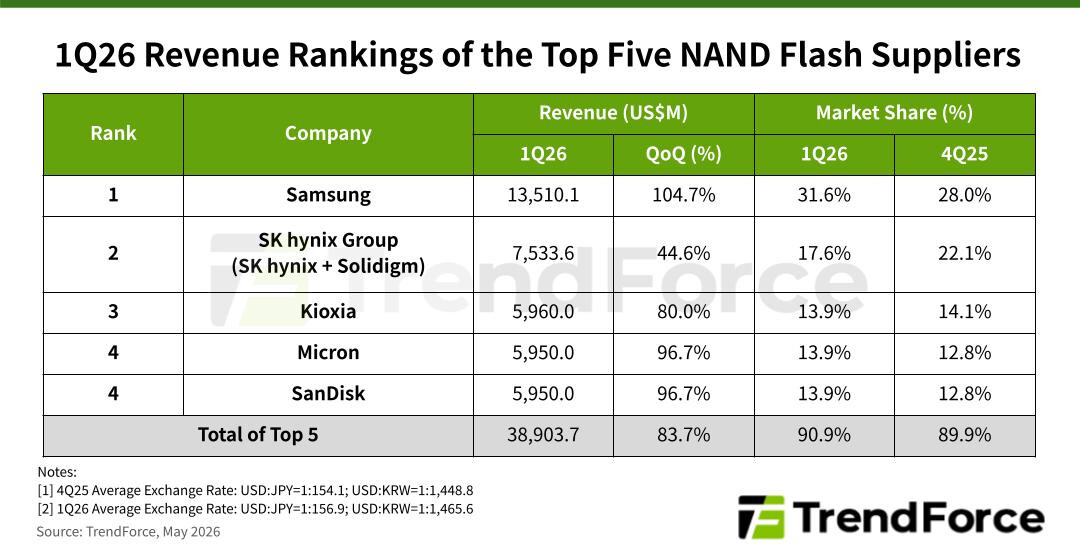
TrendForce says the top five global NAND flash suppliers saw combined revenue jump 83.7% quarter over quarter in 1Q26, topping US$38.9 billion as tight supply and strong demand pushed prices higher. The firm also expects the imbalance to continue into 2Q26, with server demand helping offset softer smartphone and PC demand.
What happened
According to TrendForce’s latest NAND flash industry survey, demand for enterprise SSDs surged in 1Q26, driven by AI server buildouts and the need for faster data movement and larger storage capacity. At the same time, a shortage of traditional HDDs appears to have shifted more storage orders toward QLC enterprise SSDs. With supply constrained, average selling prices rose beyond expectations and lifted revenue across the major suppliers.
Samsung remained the revenue leader, posting US$13.51 billion in NAND flash revenue, up 104.7% quarter over quarter. SK hynix Group followed with about US$7.53 billion, while Kioxia reached US$5.96 billion. Micron and Sandisk were tied at US$5.95 billion each, both up 96.7% quarter over quarter.
Why it matters
This matters for readers tracking SSD pricing, enterprise storage demand, and the broader memory market. The report points to a market where server-focused purchases are supporting NAND flash suppliers even as consumer demand weakens under higher prices. For buyers, that can mean continued pressure on SSD costs, especially in the enterprise and data center segments.
Key details
- Combined revenue for the top five NAND flash suppliers rose 83.7% quarter over quarter in 1Q26.
- TrendForce said the total exceeded US$38.9 billion.
- Enterprise SSD demand was boosted by AI server infrastructure expansion and HDD shortages.
- Samsung kept the top spot with US$13.51 billion in revenue and a 31.6% market share.
- TrendForce expects no major new NAND production capacity additions in 2026.
What buyers should consider
The source material suggests NAND flash pricing may remain elevated through 2Q26, with suppliers keeping ASPs high as server orders stay strong. It also notes that rising memory costs and higher end-product prices have already softened smartphone and PC demand. For buyers, especially those watching SSD costs, the supply picture still looks tight and may stay that way through the year.
Source
Source: TechPowerUp